
Goldie is one of New Zealand’s best-known artists, particularly for his realistic portraits of Māori. His original paintings sit at the top of the New Zealand auction market. But Goldie’s paintings were also reproduced as prints or chromolithographs that sell for much more manageable prices.
What is a chromolithograph? It is a colour-printing process that builds an image through multiple printed layers, traditionally using separate plates for each colour. While modern colour printing still uses similar lithographic techniques, the term “chromolithograph” is usually applied to older colour prints from the 19th and early 20th centuries.
These high-quality chromolithographs are reproductions of paintings by Goldie. They were produced and distributed in illustrated newspapers such as The Graphic and the Auckland Weekly News.
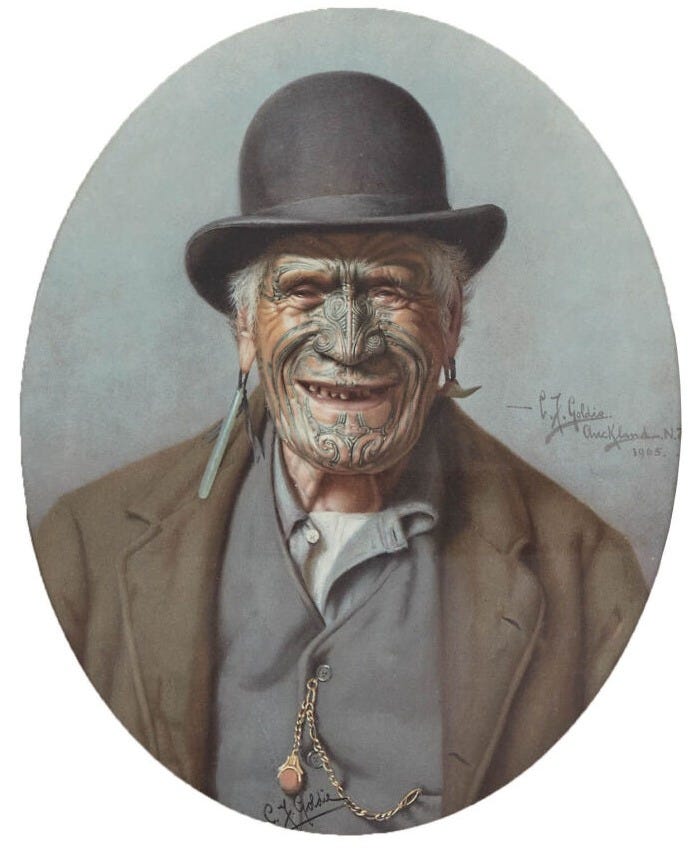
A Good Joke (All ‘e same t’e Pakeha) is probably the most well known and frequently appears at auction. It depicts Te Aho-o-te-Rangi Wharepu, a Ngāti Mahuta chief and an artist in his own right, known as an expert waka carver and tattoo (tā moko) specialist. He sat to be painted by Goldie on at least 10 occasions. According to Te Papa:
‘A Good Joke’ seems to have been available in two printings, the first in 1906, when it was offered as a supplement to the Auckland Star, and again in 1921-2, when it was described as being ‘printed in full colours on heavy art paper, and is eminently suitable for framing’ (Auckland Star, 21 January 1922, p. 6). However on both occasions, the print was not only available as a supplement, a giveaway, but also available to purchase, in which instance it could be posted in a cardboard tube! (Auckland Star, 8 November 1906, p. 6)
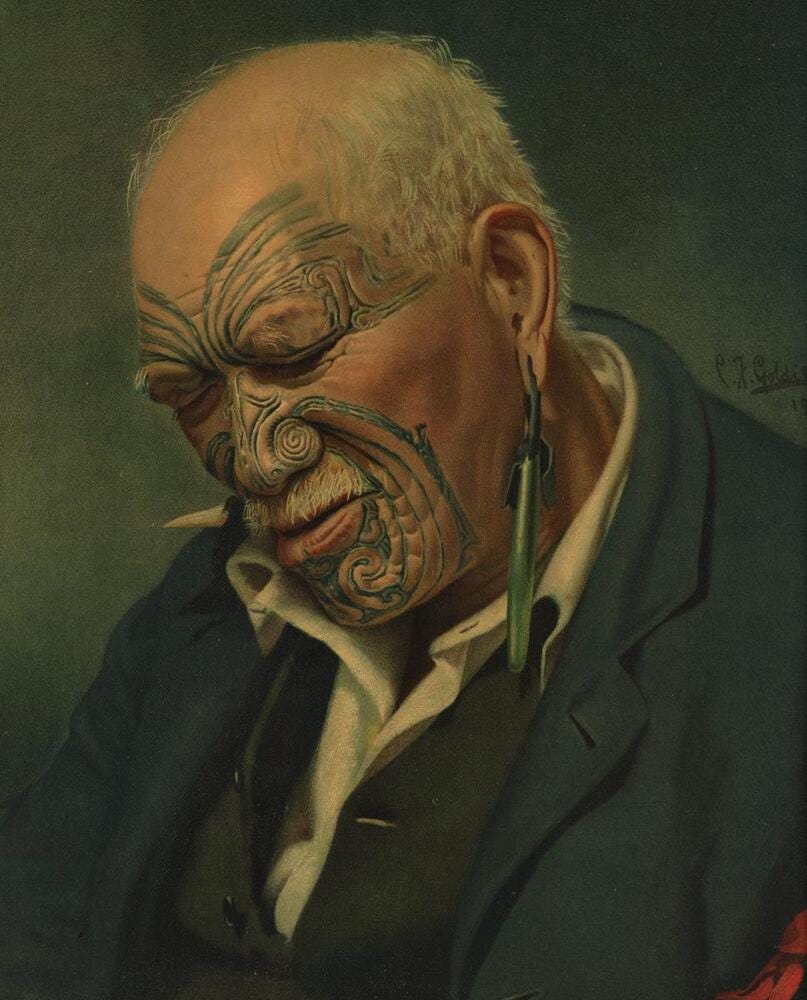
A Warm Day is another print that also often appears at auction. Sometimes called A Hot Day after the original in Christchurch Art Gallery. This work depicts Patara Te Tuhi, also a chief of Ngāti Mahuta. Again, from Te Papa:
A warm day was made available as a pictorial supplement, a ‘presentation plate’ in the Christmas issue of the Christchurch Weekly Press in 1904. Not only was the painting a work of ‘colonial reputation, but also, according to advertisements it was ‘perfectly reproduced, having received nine printings’ (“New Zealand Illustrated, 1904, Woodville Examiner, 3 October 1904, p. 2). The reproduced portrait became so familiar to New Zealanders that reference was made to it in accounts of Patara Te Tuhi’s death in 1910 (‘Personal’, Auckland Star, 2 July 1910, p. 9), and Goldie reportedly saw two copies hanging over his coffin when he attended Patara’s tangi (Roger Blackley, Goldie, 1997, p. 48).
But there were other prints too. Blackley in his book on Goldie notes that popular examples include Day Dream printed in 1902 and The memory of what has been and never more will be printed in 1905. But these two seem to rarely come at auction. Other Goldie prints that come up at auction also include A Relic of a Noble Race and various prints of Ina Te Papatahi.
The two prints that matter most at auction are A Good Joke and A Warm Day. Both are still affordable compared with Goldie paintings, but prices for these works have ranged between $1,000 and $18,000. Below, I examine how these are performing at auction and share my recommendation on buying price points.
One caveat: these works are more than 100 years old and were originally distributed through newspapers and magazines. Condition, fading, framing and later additions can all affect price. I have not adjusted for those factors below, because auction listings do not describe condition consistently.
A Good Joke
A Good Joke sold for as much as $17,000 back in 2018 and almost as much in 2020. It hasn’t reached that peak recently but even in 2022 and 2023 there were 3 sales that achieved around $13,000.
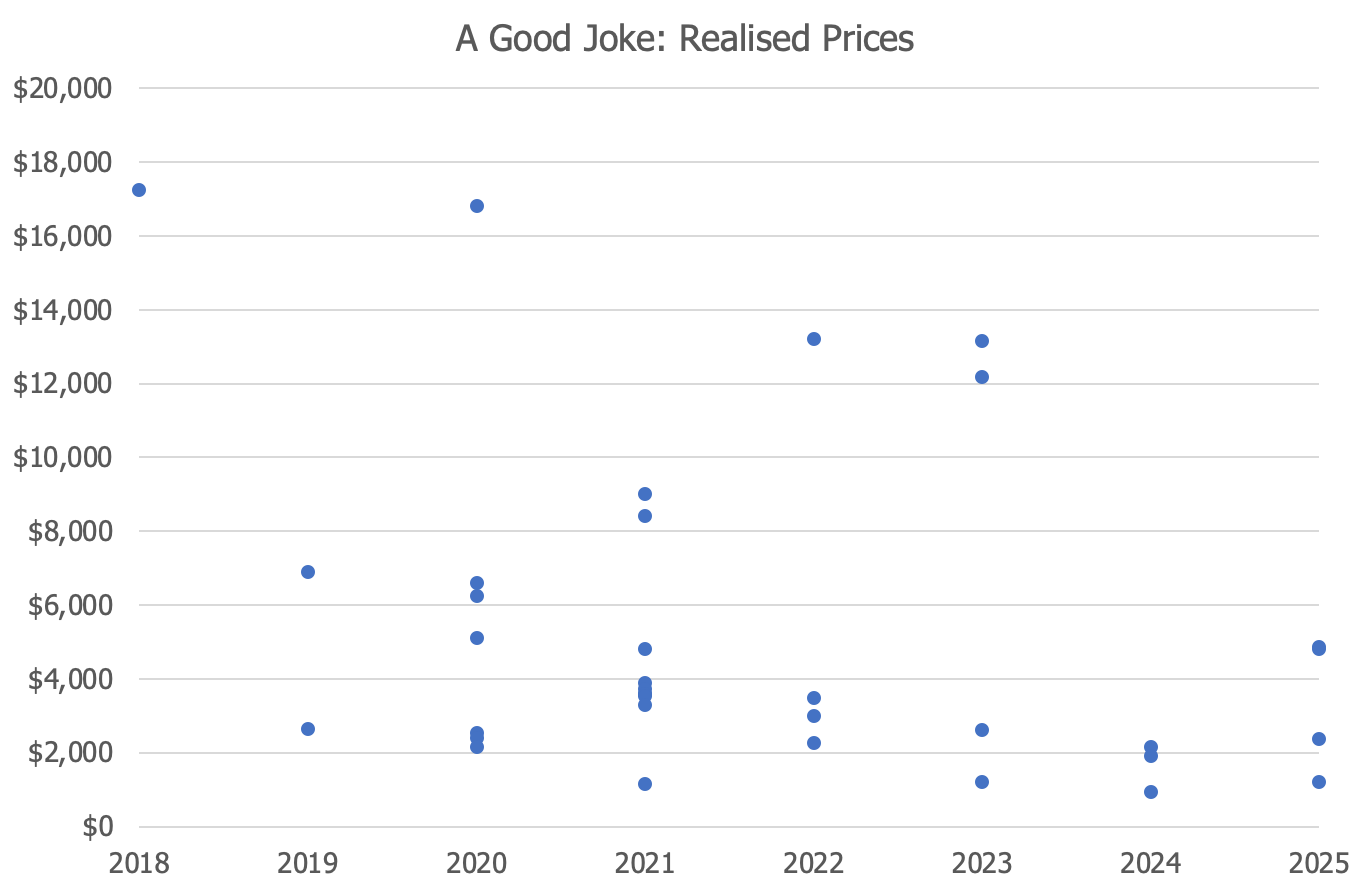
Looking more closely at the five works that sold above $10,000, there are some clear differences. The work in 2020 looks like it was in excellent condition and presented in a unique and ornately carved frame, and it came in the middle of the pandemic buying boom. As for the high point in 2018, that is an enigma: there is no obvious explanation to me why that one sold for the price it did - sometimes it just takes two determined bidders to achieve exceptional results.
The three works from 2022 and 2023 are particularly interesting. They are unique in that each appears to have been separately hand-signed or signed in ink by Goldie (look for the signature around the pocket watch in the image above). Most copies of A Good Joke are only “signed in the plate”, which means the signature is part of the printed reproduction. These are the only three works I’ve seen that have a second signature. That seems to put them in a different category and create a meaningful premium. The 2022 sale is especially interesting in that the estimate was just $1,500 - $2,500 but achieved a hammer price of $11,000. It looks like the estimates in 2023 were then revised up significantly on the back of that result.
Aside from those outliers, prices have stayed at or under $5,000 over the last four years, with most selling in the $1,000 to $3,000 range. Interestingly, one of the cheapest recent examples, which sold for just $940 in 2024, was described as having a real feather placed in the hat by the artist. So a unique touch is not always enough to create a premium. It may be that buyers were unsure whether the alteration was truly by Goldie.
A Warm Day
A Warm Day comes up less frequently at auction, but there is still enough data to make it worth a look. Prices have been more erratic than A Good Joke. There was a very strong result in 2020 and further high prices around the $10k mark in 2021 and 2022. But unlike the hand-signed examples of A Good Joke, there is no obvious single feature explaining those premiums.
From the chart below, prices are now more consistently staying below $5,000, though the market has looked thinner. Three lots offered in 2024 all failed to sell, despite low estimates between $1,500 and $3,000. That suggests buyers were becoming more selective, rather than simply accepting the higher price levels set during the pandemic-era boom. And, in fact, there have been four opportunities to buy for under $2,500 across the last 3 years.
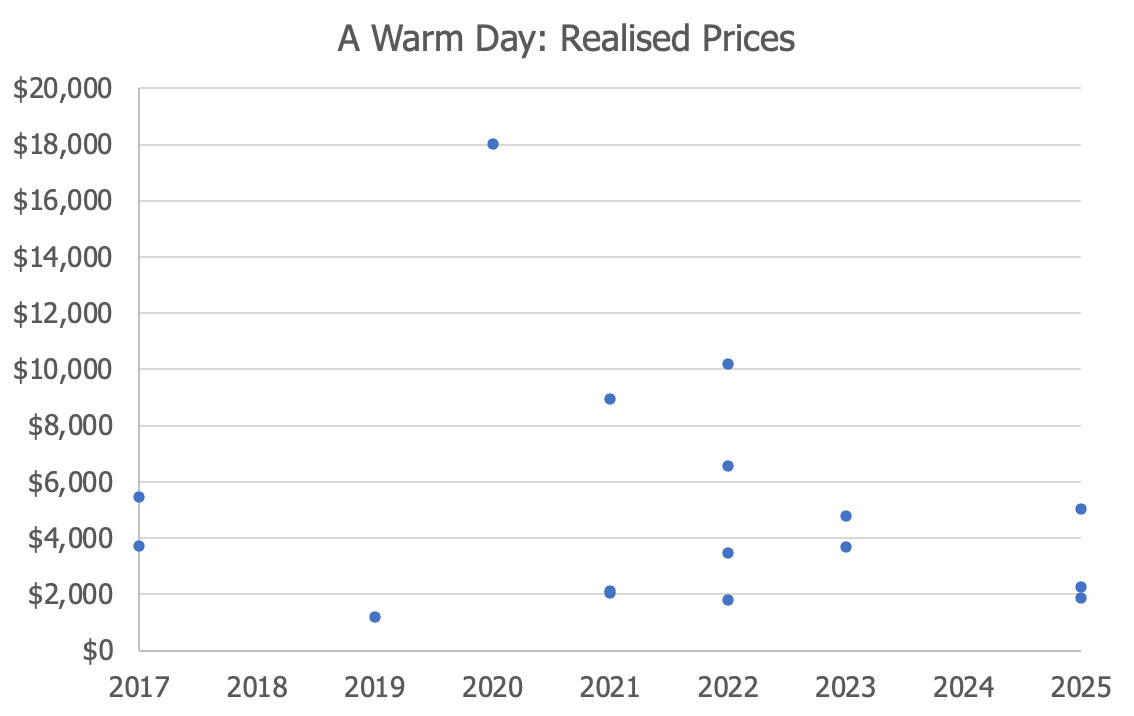
But the market in 2026 diverges. Two sold in February but at wildly different prices: one at International Art Centre for just under $2,000, and another at Art & Object for $8,530. The latter had a conservative estimate of just $1,500 - $2,500 but seems to have achieved much more because of the quality and condition of the print and (at least) two determined bidders.
The Price Tipping Point
While A Good Joke has almost always sold (87%), the sell-through for A Warm Day is not as strong (71%) at auction, and drops further when looking just at more recent years, indicating less demand for this print. For example, you can see three were offered in 2024, but none managed to sell.
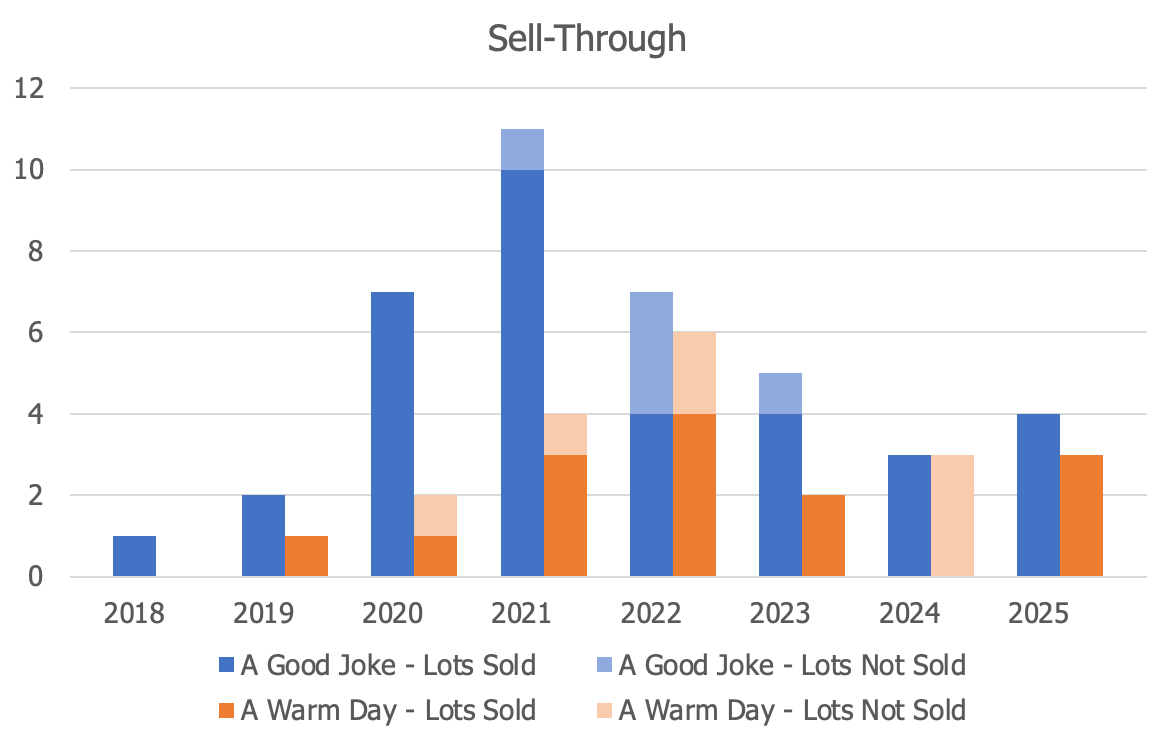
2022 looks like the point where the market became more selective for both these prints. High prices were still possible, but more lots also failed to sell, and $1,500 - $4,000 became the standard price range. That suggests after the pandemic peak of 2020 and 2021, buyers were no longer willing to chase every example at elevated estimates, unless there was something special about the work, eg. in the case of A Good Joke, a signature in ink.
Conclusions
For A Good Joke, I would now think about the market in two tiers. A standard chromolithograph, signed only in the plate, seems to be a $2,000–$5,000 object in most recent cases, influenced by condition and framing. But a hand-signed example is different. Those can justify a much higher price, and the results suggest they can push into the $12,000–$13,000 range.
That does not mean every hand-signed copy is automatically worth that much, or that an unsigned copy cannot occasionally sell strongly. The top two results in the dataset do not appear to have been hand-signed, so other factors clearly matter. But if I were buying, I would treat “signed in ink” as a fundamentally different price category.
My takeaway is that normal versions of A Good Joke should be bought with discipline and either a clear condition report or seen with your own eyes, and I would not pay more than $3,000. Personally, I wouldn’t pay a premium for Goldie’s hand-signed version, but if that appeals to you, be prepared to pay much more.
A Warm Day is harder to read. It comes up less often and sell-through is weaker. Across the full dataset, the median is around $3,700, but recent results have been thinner and more uneven. The recent February sales demonstrate works can still achieve high prices. My recommendation is the same as A Good Joke: I would hold out for a good example that I can acquire for no more than $3,000.
The key point for both works is patience. Unless you are chasing a particularly unique frame, unusually good condition, or a signed-in-ink example, these are works where I would rather wait than get dragged into a bidding war.