
Last year, New Zealand’s auction market entered the halfway point looking decidedly fragile. Sales during the first six months of 2025 were weak, the number of valuable consignments was limited and the market seemed to be losing momentum. This was not unique to New Zealand, it echoed the outlook across global auction markets.
The second half of the year offered a forceful rebuttal. Major collections and a stronger supply of high-value works helped push H2 sales close to $21 million, indicating the auction market had found its mojo again.
The first six months of 2026 landed between those two extremes.
The four major auction houses, Art & Object, International Art Centre, Webb’s and Dunbar Sloane, recorded a total of $12.6 million in sales in H1 2026, an increase of almost 8% from H1 2025. That is the encouraging headline but the details are more complicated.1
The number of works sold declined by 10%, the median sold price fell below $600 and every price band below $200,000 generated less revenue than it had a year earlier. The increase in sales was entirely attributable to 13 works that sold for more than $200,000.
Remove those works and the direction of the market reverses: sales below $200,000 were down almost 21%. So was H1 2026 a recovery? At the very top of the market, certainly. Across the market as a whole, the evidence is much less convincing.
H1 2026 by the numbers
$525,800
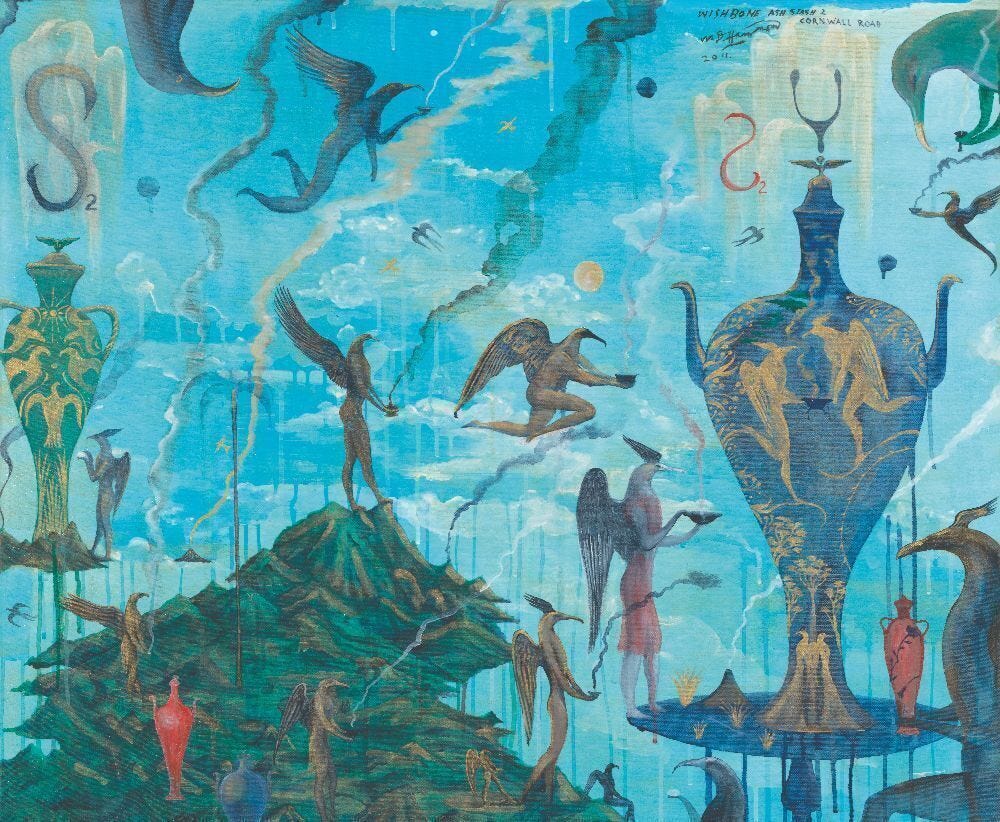
The highest price of the half-year, achieved by Bill Hammond’s Wishbone Ash Stash 2, Cornwall Road at Webb’s.
$12.55 million
Total sales across the four major houses, 7.7% above H1 2025 but 40.2% below H2 2025.
13
The number of works that sold for at least $200,000. Only six reached that level during H1 2025.
29.6%
The proportion of total sales generated by the ten highest-priced works, up sharply from 18.3% in H1 2025.
31.3%
The proportion of sales above $5,000 that were works by women artists, up from 28.1% in H1 2025. Those works accounted for 19.6% of value, about the same as H1 2025.
2,433
The number of lots sold, down 10% from H1 2025.
68.9%
The overall sell-through rate, a slight improvement on 67.3% in H1 2025.
A stronger top ten
The most immediate difference between the first halves of 2025 and 2026 can be found at the top of the results table:
Bill Hammond, Wishbone Ash Stash 2, Cornwall Road - $525,800
Charles Frederick Goldie, Te Hau - Takiri Wharepapa - $497,700
Gottfried Lindauer, Heeni Hirini (Ana Rupene) and Child - $416,500
Don Binney, Waitangiroto 21-11-1 - $379,200
Paul Dibble, The Unfolding - $377,735
Rita Angus, Moonlight, Thorndon - $341,180
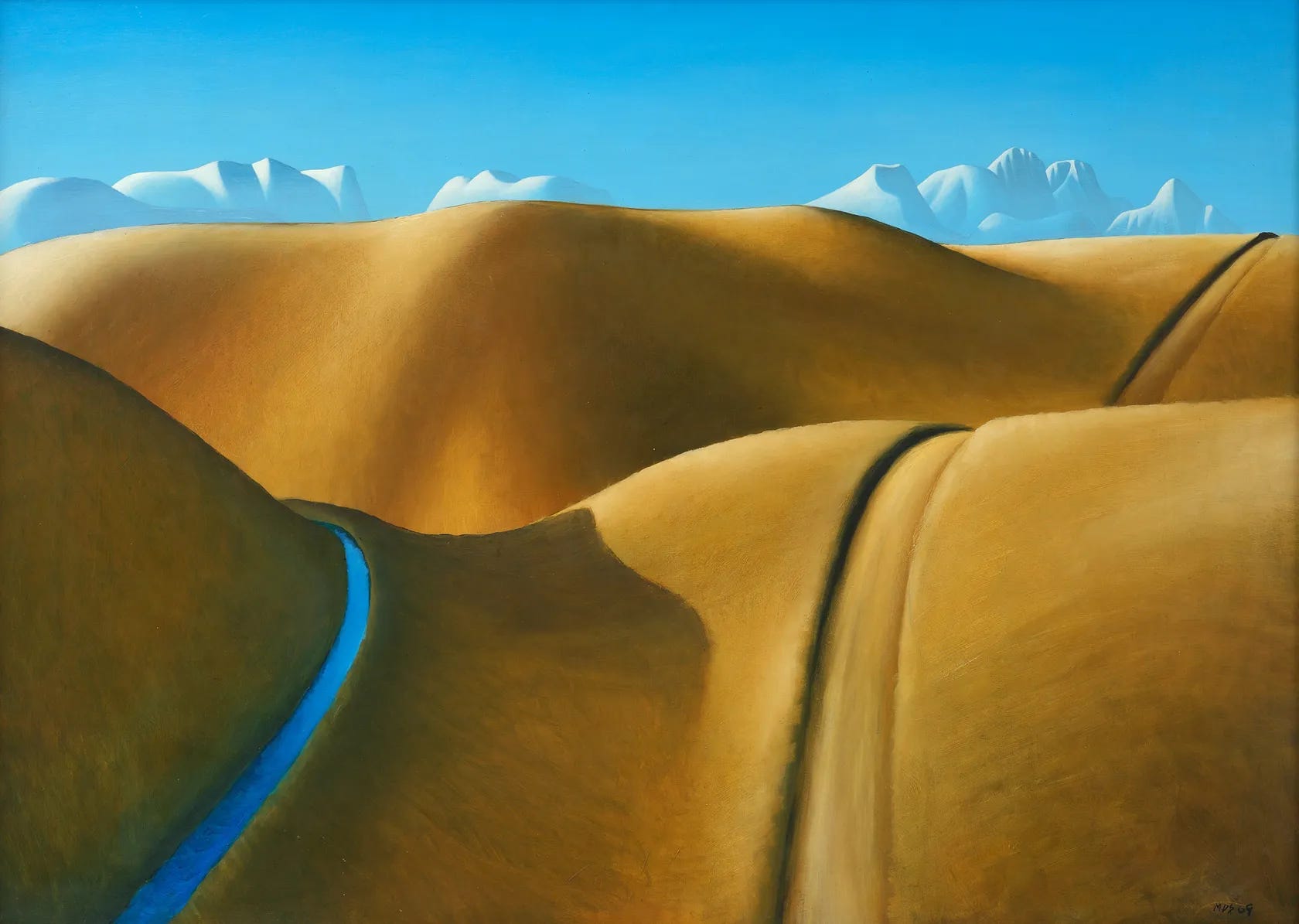
Michael Smither, Contoured Hills, Water Race and Old Road from Patearoa - $319,950
Tony Fomison, John the Baptist, from Caravaggio’s St John with Ram - $310,700
Colin McCahon, Floodgate I - $274,850
Paul Dibble, Between Two Islands - $274,163
No work sold for more than $300,000 during H1 2025. This year, eight did.
Milan Mrkusich’s Painting (Red), the $249,793 leader from H1 2025, would have ranked only 12th on the latest list.
Bill Hammond took the top position with Wishbone Ash Stash 2, Cornwall Road, which sold for $525,800 against a low estimate of $360,000. It was followed by works from two of the foundational figures in the market for historic portraits of Māori: Charles Frederick Goldie at $497,700 and Gottfried Lindauer at $416,500.
The list then moved through many of the established names that have long underpinned the New Zealand auction market: Don Binney, Paul Dibble, Rita Angus, Michael Smither, Tony Fomison and Colin McCahon. It was, overwhelmingly, a top ten of proven names.
More money from fewer works
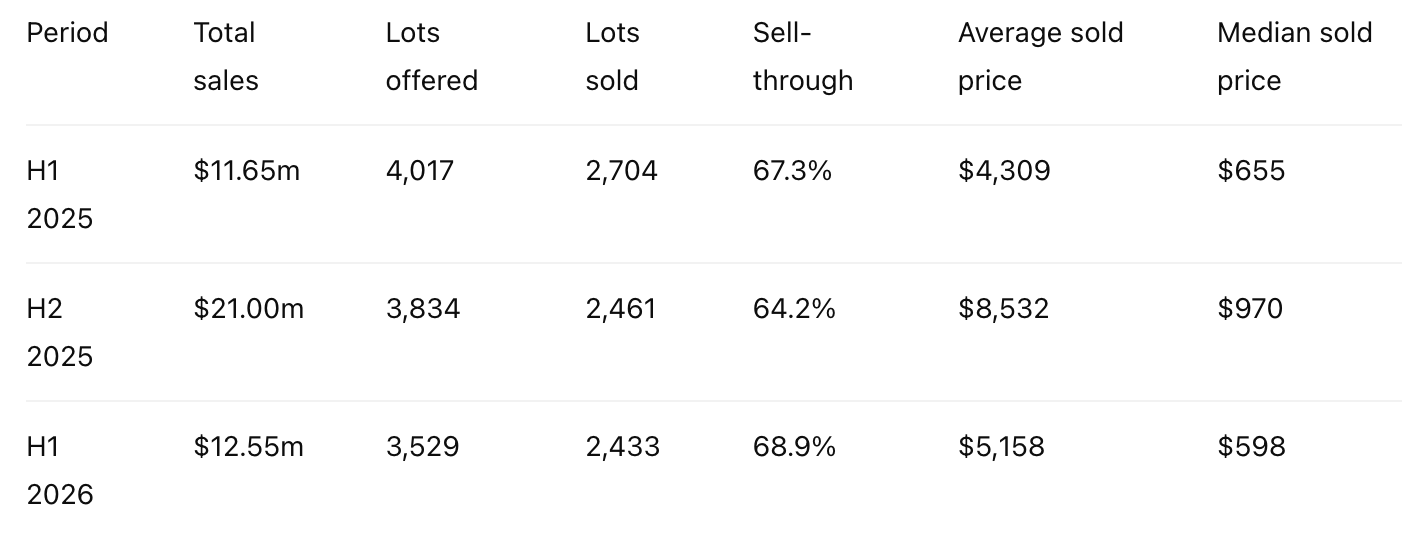
The market generated approximately $898,000 more than it did in H1 2025, despite selling 271 fewer lots.
At first glance, that might suggest buyers became more reluctant. The sell-through figures point in the opposite direction. Auction houses offered 488 fewer lots than they had a year earlier, while the proportion that sold stayed stable, increasing slightly from 67.3% to 68.9%. The fall in transactions was therefore driven primarily by reduced supply rather than a collapse in the willingness to buy what was offered.
But the price figures reveal an increasingly uneven market. The average sold price rose almost 20%, from $4,309 to $5,158. The median fell 8.7%, from $655 to $598.
When an average rises as the median falls, it is usually a sign that a relatively small number of expensive results are pulling the headline figure upwards. That is precisely what happened here. The market generated more money, but the typical sold work changed hands for slightly less.
Where the growth came from
The clearest way to see how this played out is to divide the market into price bands:
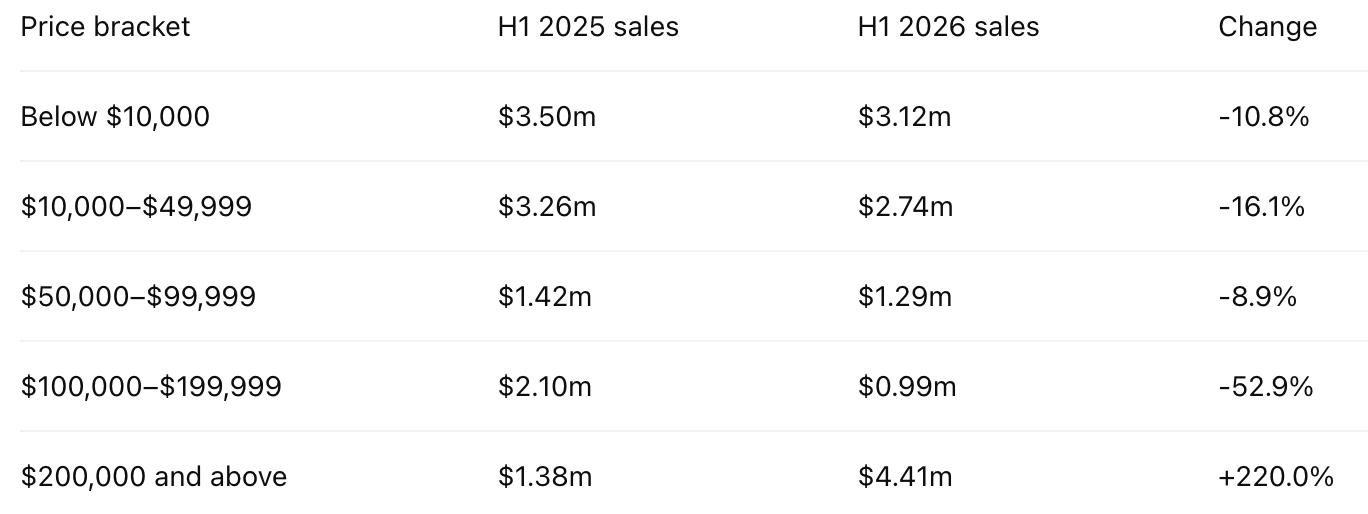
The table leaves little room for ambiguity. Every band below $200,000 declined.
Sales below $10,000 fell 10.8%. The $10,000 to $50,000 segment declined 16.1%, while the $50,000 to $100,000 range was down 8.9%. The most conspicuous weakness came between $100,000 and $200,000. Sales in that band more than halved, dropping from $2.10 million to $988,000.
Then, above $200,000, the market abruptly changed direction. Six works reached that level in H1 2025, generating $1.38 million. This year, 13 works produced $4.41 million, an increase of 220%. The number of works selling above $300,000 went from none to eight.
The concentration problem
Another way to see the dependence on major works is to remove them.
Take away the works above $200,000 and H1 2026 turnover falls to $8.14 million, compared with $10.27 million a year earlier. On that basis, the market contracted by almost 21%.
The result is a market with two different stories. For a select group of important and desirable works, demand strengthened dramatically. For almost everything else, less money was spent.
The concentration extended to artists. The ten highest-selling artists generated 44% of the half-year’s turnover, up from 37% a year earlier.
Concentration is not automatically a sign of distress. Auction totals often rise and fall with the supply of exceptional works, and high-value consignments will always exercise an outsized influence in New Zealand’s market.
The issue is what happens below them. In H1 2026, the strength at the top was not accompanied by growing sales in the middle or lower price ranges, instead, it compensated for their decline.
The artists who drove the half-year
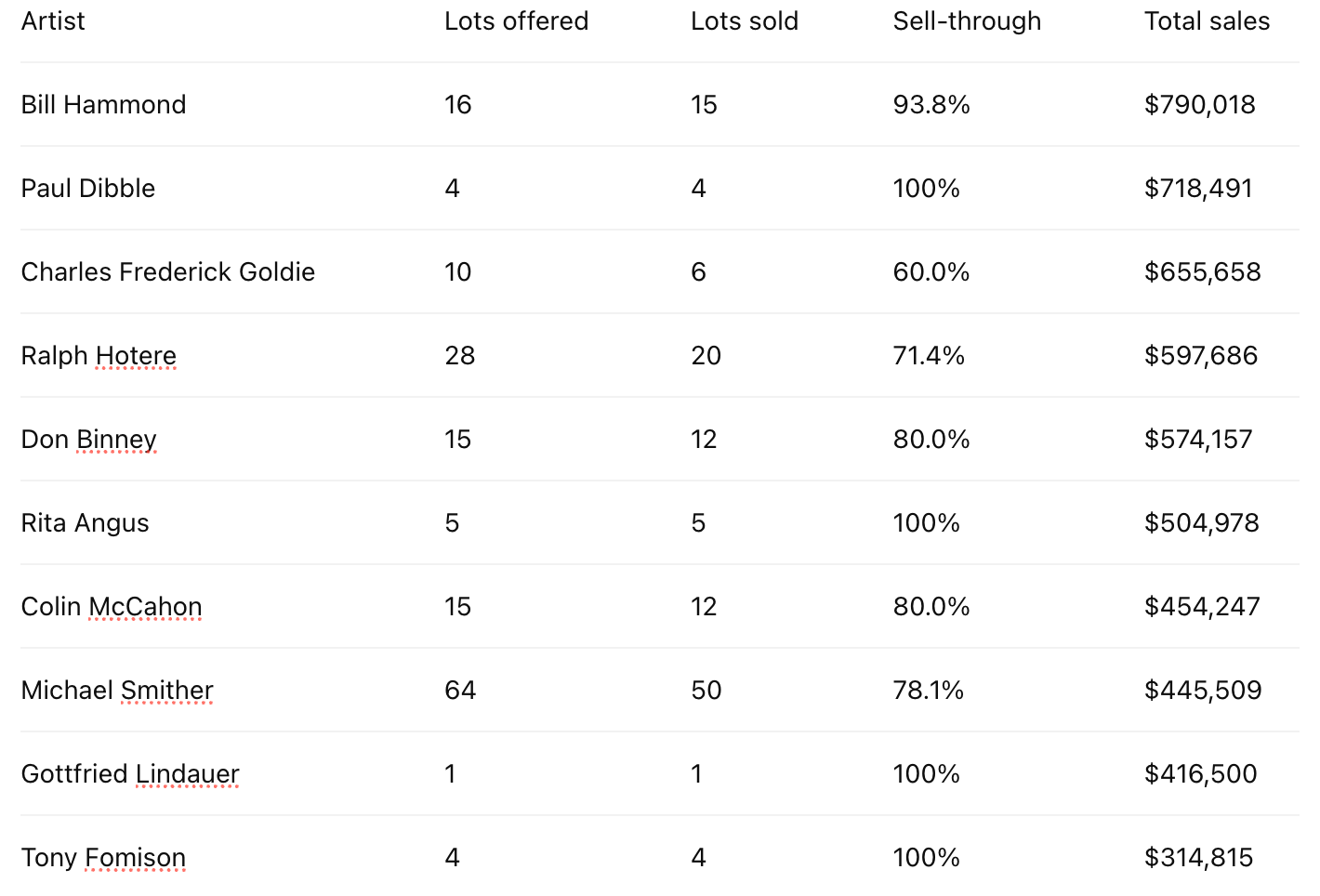
Bill Hammond led by aggregate value, although the $525,800 top lot contributed two-thirds of his total. His wider result was nevertheless strong: 15 of 16 offered works sold.
Paul Dibble had the cleanest combination of price and consistency. All four of his works sold, two appeared in the overall top ten and his $718,491 total was only narrowly behind Hammond.
Rita Angus and Tony Fomison also achieved perfect sell-through records. Colin McCahon sold 12 of 15 works, while Don Binney sold 12 of 15.
Goldie provides the obvious counterpoint. His six sold works generated $655,658, but a 60% sell-through rate shows how uneven the demand was across the ten paintings offered.
Michael Smither remained the most frequently traded major artist, with 64 works offered and 50 sold. But volume is not the same as value. Smither’s 50 sales generated $445,509, only $29,009 more than Lindauer’s single result.
Just outside the top ten, works by A Lois White generated $286,128, narrowly ahead of Fiona Pardington’s $259,229.
More works by women, but not more market value
Female artists accounted for 31% of sales above $5,000, their highest share across the three half-year periods. That is a meaningful increase from 28% in H1 2025 and 27% in H2 2025.2
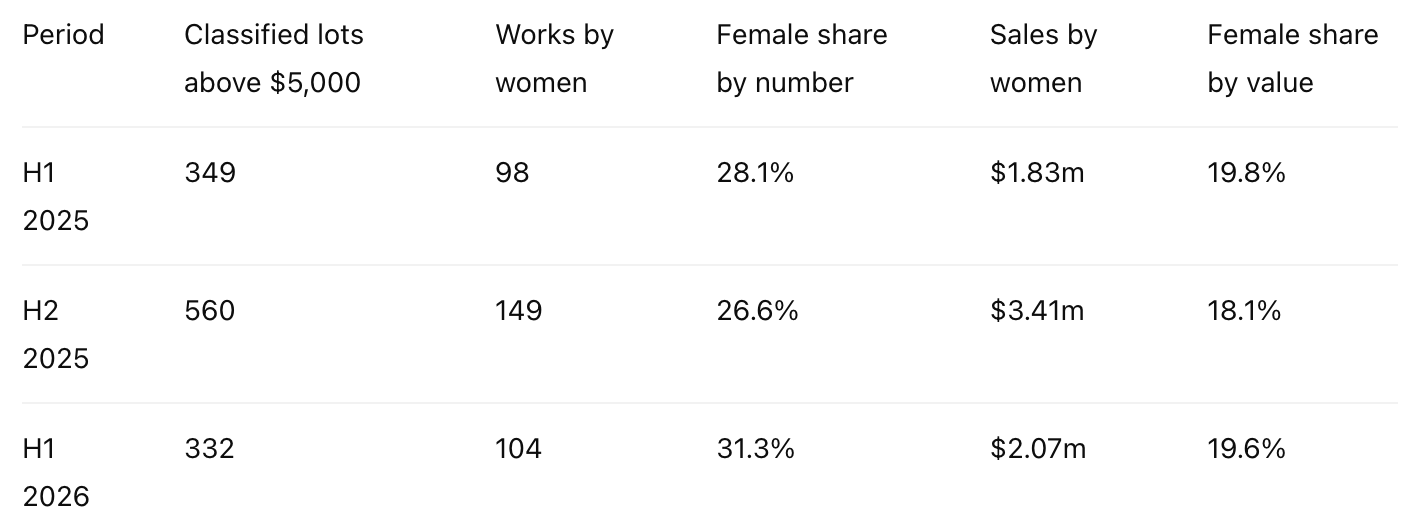
Their share of value, however, barely moved. Works by women produced 19.6% of sales, almost identical to the 19.8% recorded a year earlier.
The difference can be seen in the average prices. Among works above $5,000, the average sale by a woman artist was approximately $19,900. The $37,200 average for works by men exceeded the realised price of all but eight works by women.
The strongest results by women were:
Rita Angus, Moonlight, Thorndon — $341,180
A Lois White, Collapse — $272,550
Rita Angus, Seaside Baches — $130,350
Francis Upritchard, Future Thinker — $62,144
Louise Henderson, Untitled, Garden Party — $44,438
Fiona Pardington, Silver Winged Gull (below), Hunter — $42,648
Fiona Pardington, Pipitonu, Two Hearts Beat as One — $41,825
Gretchen Albrecht, Corolla (Pohutukawa) — $40,211
Lisa Reihana, Cooks Transit of Venus — $35,850
Judy Millar, Untitled — $32,900
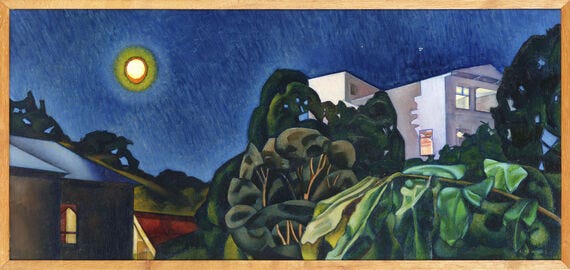
Rita Angus led by a considerable margin. All five of her works sold, generating $504,978 and placing her sixth among all artists by value.
Five of seven offered works by A Lois White sold for $286,128, led by the $272,550 result for Collapse. That placed her just outside the ten highest-selling artists overall. Fiona Pardington, also just outside the top ten, was more broadly traded, with 18 of 26 works selling for $259,229.
There was then a considerable gap to the next-highest female artist by aggregate value. Eight of nine Judy Millar works sold for a combined $99,070, followed by 15 of 17 Jenny Dolezel works at $91,871 and eight of 12 Gretchen Albrecht works at $90,706.
The picture is therefore mixed. Women were represented across more meaningful transactions, and several artists generated strong sell-through. But the most valuable tier remained dominated by men. Only two works by women appeared among the 20 highest-priced lots.
Strong bidding, selectively applied
What is often interesting is seeing which lots attracted fierce competition resulting in prices significantly above their estimates. Around 30% of sold works reached at least 1.5 times their low estimate, while 18% doubled it.3
Some of the strongest results combined high multiples with six figure prices delivering substantial premiums over expectations:
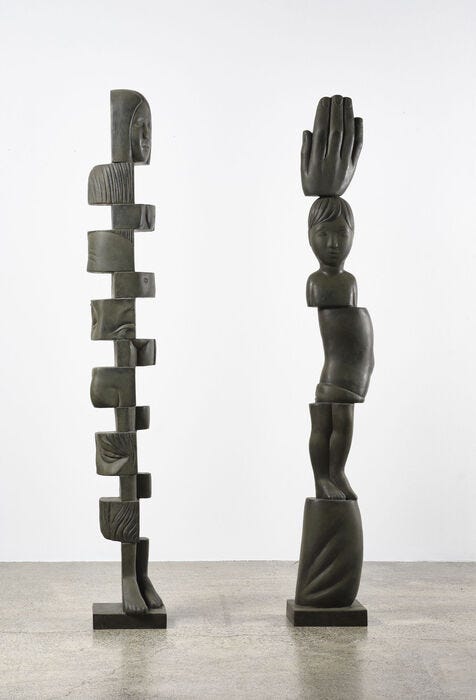
Terry Stringer’s sculpture Intercut Artist and Model and Intercut Child and Reaching Hand realised more than three times its low estimate, $155,968 against a low estimate of $50,000;
Ralph Hotere’s Kyrie Eleison Requiem exceeded $200,000 from an $80,000 starting point;
Paul Dibble’s Between Two Islands added more than $134,000 to its low estimate on the way to realising $274,163.
At lower price levels, the multiples were more dramatic, even if the headline numbers were not:
Kawase Hasui’s Zojoji Temple in Shiba — from Twenty Views of Tokyo realised $10,710 against a low estimate of only $300, or 35.7 times that figure.
Don Binney’s Kaka Great Barrier was another notable result, achieving $60,435 from a $15,000 low estimate;
Peter Wichman’s Woman Near Manhole sold for $10,961 from a $1,000 low estimate;
Liam Barr’s Faethm reached $33,320 against $5,000;
Manos Nathan’s Tunatahi sold for $12,185 against $3,000; and
Nigel Brown’s Destruction of the Endurance sold for $21,330 against $6,000.
The Goldie test
The limits of the top-end recovery were most visible in the market for Charles Frederick Goldie.
Te Hau – Takiri Wharepapa sold for $497,700, making it the second-highest result of the half-year. Goldie also finished third among artists by aggregate sales, with six sold works generating $655,658. Yet four Goldie paintings carrying combined low estimates of $2.21 million failed to sell:
At the Tangi, The Chief is Dead, His Widow Mourns, $620,000 to $800,000 estimate;
Sad Memories: Ngaheke, $590,000 to $750,000 estimate;
Memories: Harata Rewiri Tarapata, $550,000 to $700,000 estimate; and
Portrait of Te Aho o Te Rangi Wharepu, $450,000 to $550,000 estimate.
This was not a market buying Goldie at any price. It was a market differentiating sharply between individual paintings and the expectations attached to them.
The same selectivity appeared elsewhere with these works going unsold:
Michael Smither, Mountain Stream, Taranaki, estimated at $200,000 to $300,000;
Don Binney, Fell Swoop, Te Henga, estimated at $150,000 to $220,000;
Frances Hodgkins, St. Ives, estimated at $150,000 to $250,000;
Gretchen Albrecht, Sea Screen No. 1, estimated at $100,000 to $140,000; and
Pat Hanly, Protective Helmet, estimated at $80,000 to $100,000.
These are not obscure artists, but these were arguably good rather than great works, or in the case of the Albrecht work, an atypical medium. These failures reinforce that buyers will compete hard for the works they want, but reputation alone is not enough to overcome ambitious pricing.
Recovery, with qualifications
There are several reasons to view the results positively.
Sales increased by 7.7%. Sell-through improved. Thirteen works exceeded $200,000, more than twice the number in H1 2025. Major works by Hammond, Goldie, Lindauer, Binney, Dibble, Angus, Smither, Fomison, McCahon and Hotere found buyers, often at prices comfortably above their low estimates.
But the broad numbers conceal a narrower recovery than the headline suggests.
Fewer lots sold. The median price declined. Every price band below $200,000 contracted. The ten highest-priced works generated almost 30% of total turnover, while the top 20 produced more than 42%.
And even at the top, buyers were selective. A strong result for one Goldie did not prevent four others from failing to sell. Significant works by Smither, Binney, Hodgkins, and Albrecht were also passed in.
The best works are still capable of drawing determined bidding, and the supply of those works was markedly better than it had been a year earlier. But there is not yet evidence of the same improvement spreading through the middle of the market.
A broader recovery would require stronger spending between $10,000 and $200,000, a rise in the median price and less dependence on a small group of flagship consignments.
For now, the top end is back. The rest of the market is still waiting.
This analysis covers auction results from January to June 2026 across the four major auction houses: Art & Object, International Art Centre, Webb’s and Dunbar Sloane. All values are in New Zealand dollars.
Gender analysis is limited to sold lots with realised prices above $5,000. The reason for a $5,000 cutoff is that the data for gender across the long tail of auction results below this threshold is much less reliable. Sales above $5,000 reflect over 95% of total sales value. Shares by number and value exclude the small number of eligible lots for which gender was not recorded.
Realised-price-to-estimate calculations compare the recorded realised price with the published low estimate. Realised prices generally include buyer’s premium, while estimates generally do not. These comparisons should therefore be interpreted as directional rather than as direct measures of hammer-price performance.
Bravo! A first class analysis.