
This analysis is drawn from my 2025 New Zealand Art Auction Market Report. A comprehensive, data-driven review of the year’s key results, trends, and pricing signals. What follows is an extended excerpt highlighting the works that most dramatically exceeded expectations. You can download the full report below.

Auction estimates are intended as pricing guides, but in some cases competitive bidding can push results well beyond expectations. The works listed below are the ten lots that exceeded their high estimates by the largest margins in 2025.
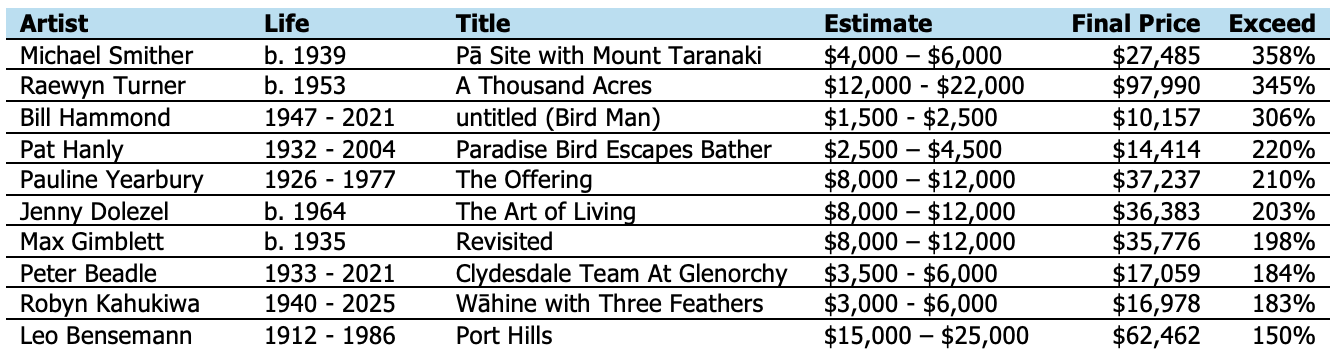
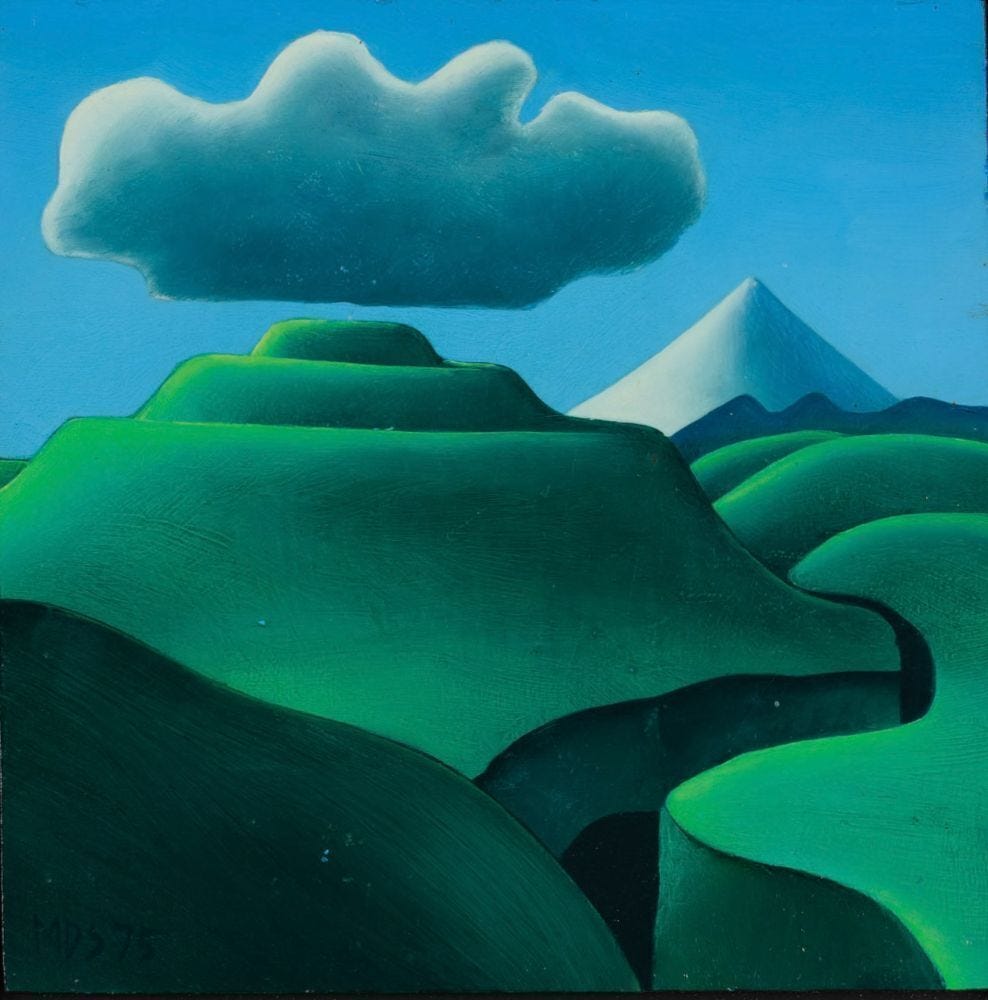
At the top of the list was Michael Smither’s Pā Site with Mount Taranaki, which sold at Webb’s for $27,485 against a high estimate of $6,000, a result more than four times expectations. While Mt Taranaki is a recurring motif in Smither’s work, this remains a striking outcome for a painting measuring just 15 × 15 cm, underscoring the strength of demand for the artist regardless of scale.
Raewyn Turner’s A Thousand Acres also significantly outperformed expectations, achieving $97,990 at Webb’s against a high estimate of $22,000. The work’s cultural significance as the cover image for Frenzy (1979) by Split Enz likely attracted interest beyond the traditional art-collecting audience, contributing to the competitive result.
Several other results reinforce the depth of demand below the very top end of the market. Jenny Dolezel’s The Art of Living sold at International Art Centre for more than three times its high estimate, confirming that despite reduced supply in 2025, appetite for her work remains strong following a highly active period in 2023 and 2024.
It is worth noting that percentage-based overperformance tends to favour lower-priced works. Achieving a threefold increase on a $10,000 estimate is materially easier than doing so on a six-figure painting. Even so, two of the most expensive works of 2025 achieved results close to double their high estimates. Jeffrey Harris’ Jillian and Brothers sold for $194,960 against a high estimate of $95,000 at Art & Object, while Peter Stichbury’s Savannah realised $254,678 against a high estimate of $130,000 at International Art Centre. Both sales set new auction records for these artists.
Were these prices justified?
Every bidder should have a view on what a work is worth before the auction begins. Not what it might reach in the heat of competition, but what it is worth to them based on context such as past prices, scale, rarity, quality, and broader market context. That view helps define where you should stop.
Of course, auctions are not purely rational environments. Sometimes something more primal takes over, the desire to win, to secure the work at any cost. That instinct is part of collecting. There is nothing wrong with giving in to it. But if you are going to override your own valuation, do so consciously and with context, rather than impulsively and without it.
From that perspective, $27,485 for a 15 × 15 cm Michael Smither feels ambitious. Similarly, $14,414 for a Pat Hanly print appears strong when two examples from the same edition achieved approximately $3,400 just a year earlier.
By contrast, the Robyn Kahukiwa work was widely described as exceptional and sometimes quality justifies deviation from precedent. Meanwhile, the near-doubling of high estimates for Jeffrey Harris and Peter Stichbury may represent something more structural: a potential re-rating of where these two artists rank amongst New Zealand’s best.
These results may mark a genuine shift in what the market is willing to pay for certain artists. Or they may prove to be outliers. Only time will tell which proves true.