
This analysis is drawn from my 2025 Australian Fine Art Auction Market Report. A comprehensive, data-driven review of the year’s key results, trends, and pricing signals. What follows is an extended excerpt highlighting the top selling artists in 2025. You can download the full report below.

This week, we look at the top-selling artists by total auction sales value in 2025. These rankings do more than highlight the biggest names. They show where demand is strongest, where momentum is building, and where the market may be starting to shift. For collectors of Australian art, the names on this list are worth watching closely, particularly when new artists appear, as that can signal a change in market attention and point to artists worth following more closely.
Headline prices can make these artists seem unattainable, but the broader auction results reveal more buying opportunities than may first appear. Many of these artists still have prints or works on paper trading at far more accessible levels. The median price for an Arthur Boyd was just $1,750, 16 works by Brett Whiteley sold for under $10,000, and Sidney Nolan had 379 works sell for under $5,000, with the median just over $1,000, helped by the sale of a significant collection of his prints.
Even where the median was higher, entry points still existed: Bessie Davidson, Cressida Campbell, Criss Canning and Del Kathryn Barton each had works selling for around $10,000 or less, as did Howard Arkley, Arthur Streeton and Jeffrey Smart.
Below are some of the more revealing results and observations behind the top 10 rankings for both male and female artists.
Male Artists in 2025
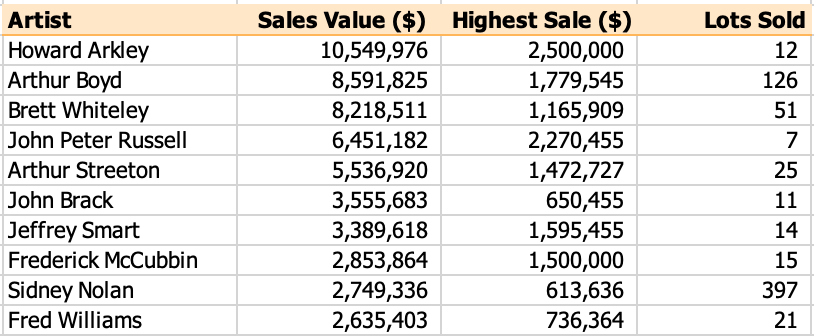
Howard Arkley was the standout performer of 2025, topping the market with $10.6 million in sales and reinforcing his position as Australia’s leading contemporary artist at auction. Contemporary Units sold for $2.5 million at Smith & Singer, setting a new auction record for Arkley as well as the highest Australian auction result of the year. Another three Arkley works sold between $1.8 million and $2.5 million. Arkley’s placement at the top was driven not by volume, but by an extraordinary concentration of value in just four paintings, which together generated almost $9 million.
Arthur Boyd’s result showed both depth and breadth. A collection of prints from Tony and Indra Deigan, who had collaborated with Boyd to produce them, added volume to the market, but it was the major works that drove his ranking. Bride in the Hibiscus Bush sold for $1.78 million at Smith & Singer, the second-highest price achieved for a Boyd work, while a further 20 works sold for more than $100,000. Boyd’s market has also shown consistent growth over the past six years, indicating continued interest from collectors.

John Peter Russell was the clearest example of how scarcity can still produce top-tier results. He was the only artist in the top group with fewer than 10 works sold, yet three significant works each achieved more than $1 million, securing his place among the top sellers. With supply so limited, Russell’s best works tend to command major prices whenever they appear. Though in 2024 three watercolours by him each sold for under $10,000 which presented an interesting buying opportunity.

Sidney Nolan, by contrast, reached the top 10 through volume rather than trophy prices. A significant group of works from his wife’s estate came to market, pushing the total number of Nolan works sold in 2025 to almost 400. Only five sold for more than $100,000, but the sheer quantity of works traded was enough to place him among the year’s top sellers.
Fred Williams and Charles Blackman help illustrate two different reasons an artist can fall back in the rankings. Williams, usually a top-three name, appears to have slipped largely because of supply: aside from some lower-value works, those that came to market sold well. Blackman’s result looks different. Buyer demand appeared softer, with three works estimated above $100,000 failing to sell, including Alice Amongst Flowers, which carried an estimate of $700,000–$900,000.
Overall, the familiar Post-War names still dominate the top male sellers. However, 2025 also hinted at a modest rebalancing, with more Impressionist & Modern artists taking a larger share, particularly when the lens is widened to the top 20.
Female Artists in 2025
Emily Kame Kngwarreye and Grace Cossington Smith were the standout female performers of 2025, and both would have made a combined top 10 ranking of Australian artists overall. At the same time, the results also underline a broader structural reality: women remain under-represented at the top tier of auction sales. That is why I have highlighted the top-selling female artists separately below.
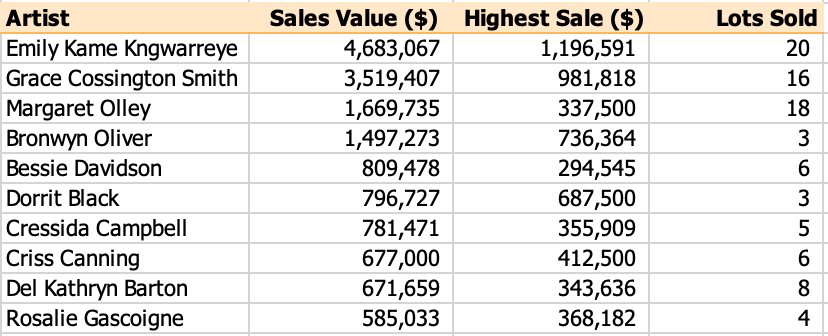
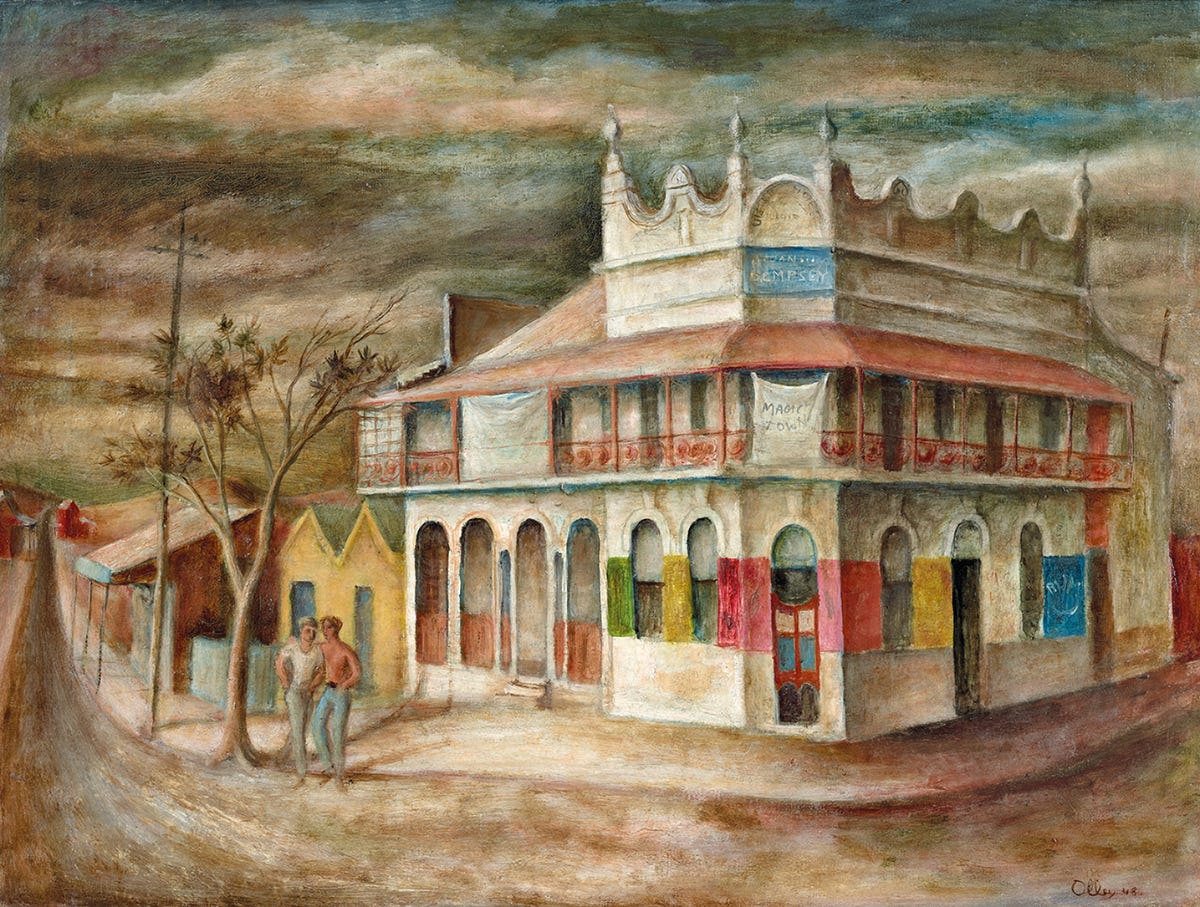
Across the most bankable female artists, several auction records were set. Emily Kame Kngwarreye, Grace Cossington Smith, Margaret Olley, Dorrit Black and Criss Canning each achieved new record prices.
Sell-through rates reinforce that strength in demand. Smith, Canning and Black each recorded perfect sell-through rates, along with Bessie Davidson. In addition, Olley, Cressida Campbell and Bronwyn Oliver each had just one work fail to sell. Taken together, these results point to a market with strong buyer appetite whenever top works by women come to auction.
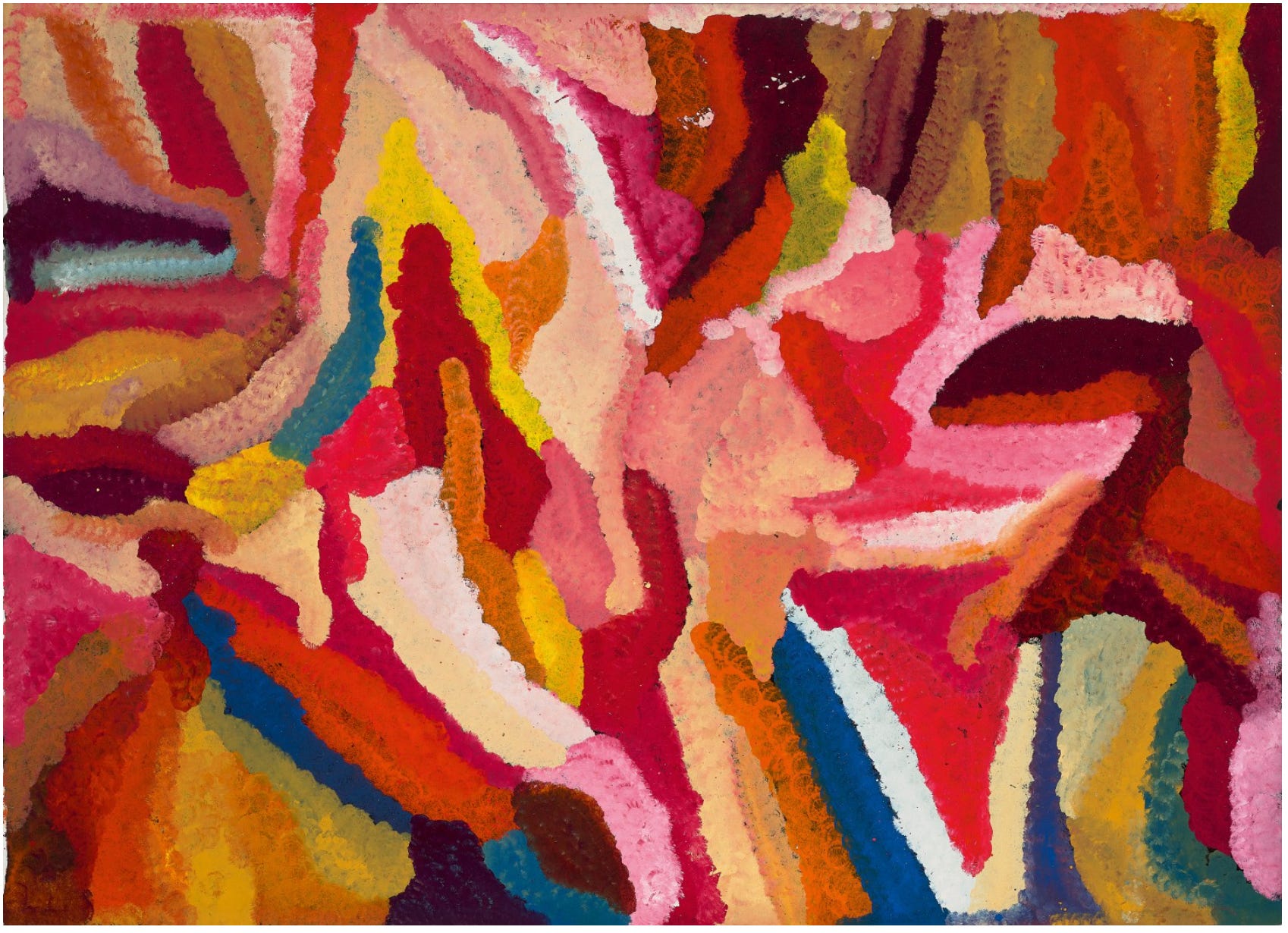
Emily Kame Kngwarreye’s major retrospective at Tate Modern opened in 2025, further strengthening the global recognition of her work and likely supporting the sale of Untitled (Awelye) for $1.2 million at Deutscher and Hackett.
Dorrit Black’s sale of Sicilian Mountain was one of the most striking results of the year. It achieved $687,500, far above its high estimate of $180,000, selling at Smith & Singer. The result was made even more significant by the fact that the work was acquired by the Art Gallery of South Australia and is included in the Dangerously Modern exhibition currently on at the Art Gallery of New South Wales.
Cressida Campbell’s absence from the very top of the rankings looks more like a supply story than a demand story. In recent years she has regularly ranked among the top two or three female artists, but the limited number of works coming to market this year clearly affected total sales. Margaret Preston offers a similar example as she is a regular top-10 presence, but without top-tier works appearing, she dropped out of the rankings.
In recent years, Cressida Campbell’s works have placed her among the top two or three female artists, but the lack of supply this year had a noticeable effect on total sales. Margaret Preston is also a regular name in the top 10, but a lack of top-tier works meant she did not appear this year.
Overall, there is strong demand for top-tier works by women, limited mainly by the supply of what comes to market.
Final observations and predictions
One striking pattern is the greater age diversity among female artists, with multiple artists represented across each generation. By contrast, almost all of the male artists in the top group were born within a narrow 20-year window (late 1910s to late 1930s). This is a similar pattern to New Zealand.
Breaking the top 10 by age segment adds another layer to that picture. Women show their strongest representation in the Contemporary category, making up four of the top 10: Bronwyn Oliver, Cressida Campbell, Criss Canning and Del Kathryn Barton. By contrast, women remain much less represented among the top-selling Impressionist & Modern and Post War artists. Supply is clearly part of the explanation, because, as noted above, many of these artists perform strongly when their works do come to auction.
Looking ahead to 2026, there is a global trend of interest shifting away from Contemporary artists and towards Impressionist & Modern and Old Master artists. In a more uncertain market, collectors are gravitating towards artists with finite supply, proven reputations and longer track records at auction. At the same time, softer demand for Contemporary art suggests some buyers believe prices in that segment had run ahead of fundamentals. I expect to see a similar trend in Australia, though much will depend on whether top works by these earlier artists come to market.
Methodology note: All prices include buyer’s premium. Where buyer’s premium was not published, it has been calculated using the auction house’s stated rate.