
Fiona Pardington’s Venice moment has arrived. She is representing New Zealand at the 2026 Venice Biennale with Taharaki Skyside, a presentation centred on large-scale portraits of taxidermied native birds from museum collections. Pardington has long been one of New Zealand’s most important photographic artists, but Venice puts her work in front of a much wider audience.
Though her practice is broad, the highest prices at auction closely align with the body of work she is exhibiting in Venice. The large native bird photographs, especially the huia and the dramatic spread-wing diptychs, are where collectors have been most focused.
Below, I take a deeper look at what her works are achieving at auction and give my recommendations on what I would buy and at what price.
But first, don’t forget to subscribe for future insights and buying recommendations.
There are two big variables in Pardington’s auction prices: the subject matter and the size. A large work in a less familiar subject is not the same as a large huia. A small heitiki is not the same market as a small early photograph. But together, subject and size explain a lot of the price movement.
I look first at subject matter, then size, before taking a closer look at the two areas collectors are most likely to focus on: huia and heitiki.
Subject Matter
Across her career, Pardington has portrayed several distinct subjects. The most important, commercially and visually, is the huia. These extinct birds survive physically through museum specimens and individual feathers.
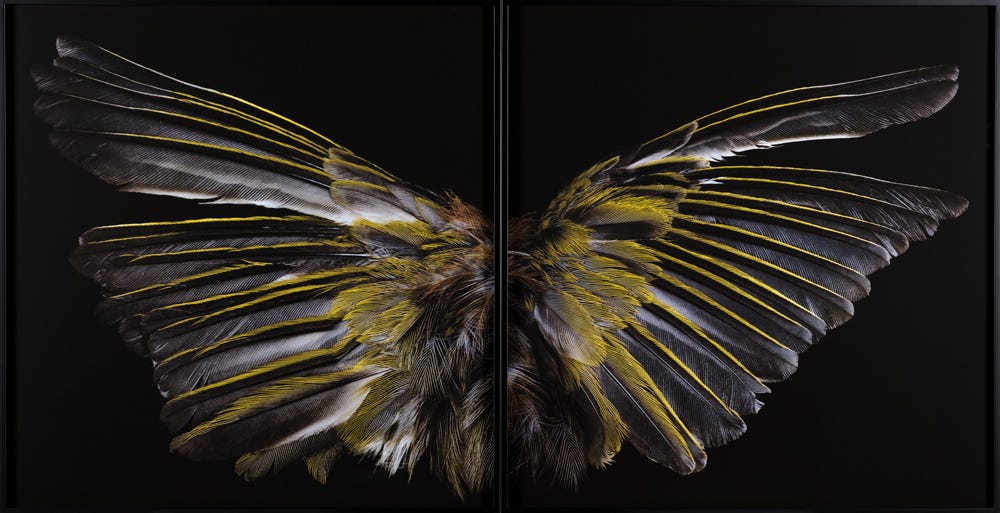
Alongside the huia sits the broader category of native birds. Within that, I have separated out two groups: kiwi and the native wing diptychs. Kiwi are her second most common bird subject at auction, though well behind huia. The winged works are different again. These are presented as large diptychs of just the wings, photographed from either above or below, and they are among Pardington’s most dramatic and sought-after photographs.
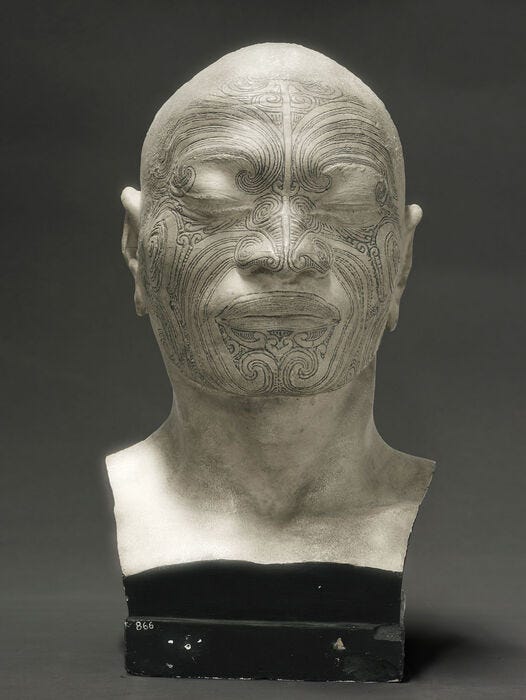
I’ve also separated out her heitiki, life casts, and still life works.1 The heitiki works have been part of Pardington’s practice for a long time and remain relatively affordable compared with the works of native birds. The life casts, first shown in 2011, depict casts of human heads made during voyages by the French around the Pacific in the 1830s. The still life works appear to have grown out of her McCahon House residency and have since become a recurring part of her practice.
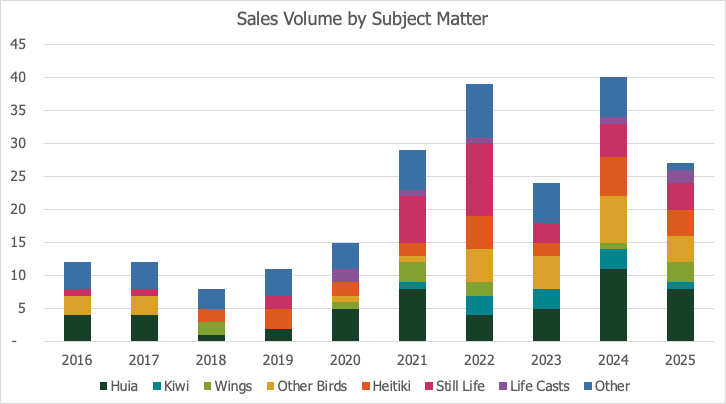
The graph above shows how important birds have become to the market. In most years, the various bird works make up roughly half of Pardington’s auction results. The heitiki works are also consistent, appearing at auction almost every year and going back well beyond the period shown in the graph. Still lifes also appear regularly, while there also continues to be steady sales of her earlier photography captured in the “Other” category.
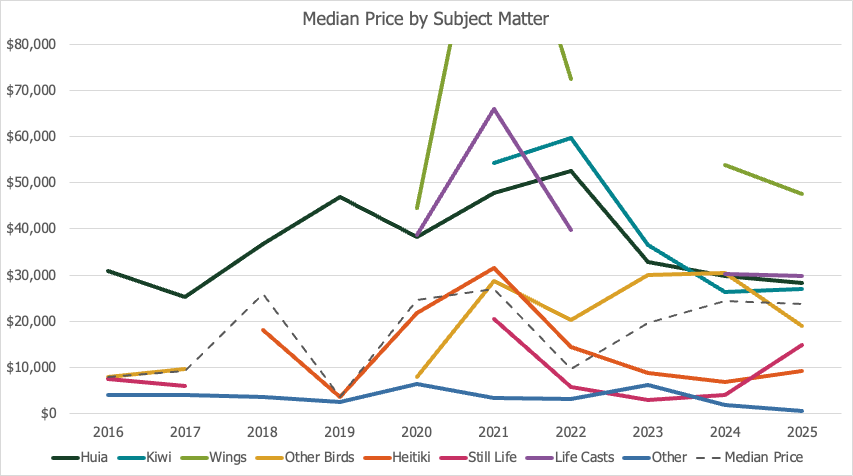

The graph of prices and the table of sell-through rates tell a clearer story of how subject matter shapes demand and prices.
Sell-through rates are a useful check on demand because they show how often works actually sell at auction. High sell-through rates are a good indication those works (or that artist) are in hot demand.
The spread-wing works sit at the top, so much so that it’s off the charts in 2021,2 with a median price of $55,000, helped by major results for works such as Davis Kea Wings and Ruru Perfect Prince. Of the 13 winged lots offered over the last decade, 12 sold, giving a 92% sell-through rate. The sample is relatively small, but the high median price and the consistent demand are hard to ignore.
Not surprisingly, the huia works are also strong. 52 works have sold over the last decade, with sales every year and a median price around $33,000. The sell-through rate is strong at 79% confirming that these works are sought after. Importantly, huia works account for roughly $1.9 million in auction sales value across the decade, making them also Pardington’s most important subject category by total auction value.
Pardington’s kiwi works achieved high prices during the pandemic, but those prices have converged closer to the other native birds in the last few years. The median price of a kiwi work is now closer to $32,000 while the median for other native birds has increased to $29,000. By sell-through rate, kiwi works are only slightly stronger than the broader bird category, so even though they are a significant category, they are not in much more demand than other native birds.
At the lower end of the price spectrum, the heitiki works have a median price of $9,000 over the last decade, and have generally sold below $10,000 in recent years. Of 34 heitiki works offered, 26 sold, giving a 76% sell-through rate, at the higher end of demand. For collectors priced out of the huia and other native birds, the heitiki works are an obvious place to look with the lower price point and solid demand.
Still life and life cast works often sit in different places on the price spectrum, but both perform respectably, roughly in line with the sell-through rates of the broader native bird category. Meanwhile, Pardington’s early photography, captured in the “Other” category, has a lower sell-through rate of about 60%, suggesting that the market is more selective with these earlier or less immediately recognisable Pardington works. Even so, they offer the most affordable pricing.
While it would be easy to conclude that the subject is all that matters, we’ll see below how size of the works also impacts price.
Size Matters
While subject matter is a significant part of the story, size is also a major contributor in influencing price.
In the earlier years of the auction data, Pardington’s market was dominated by smaller works. Around 2010, with the life cast works, she began operating on a larger scale. It then took several years for those larger works to move through collections and into the secondary market. From 2018 onward, those large works have become a much bigger part of the auction market. It’s an important shift, as those larger works pushed the price ceiling higher.
Pardington’s works are not completely standardised, but they do fall into broad size bands. I’ve labelled these as XS through to XL, while the the large diptychs are labelled 2X.3
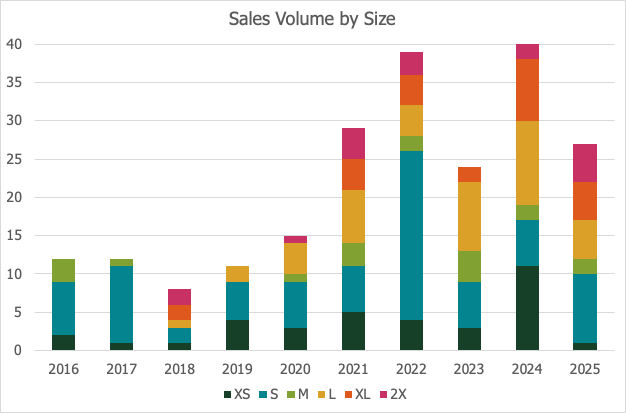
Small works have been part of Pardington’s practice and auction history for a long time. What has changed in the last decade is the arrival of larger works in meaningful numbers that now also represent around half of her auction sales each year.
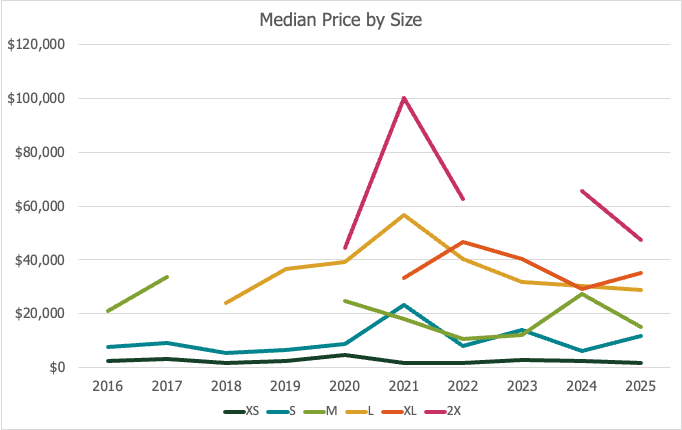
The price data confirms the point that bigger works generally command higher prices. The relationship is not perfectly linear, and buyers appear to treat L and XL works similarly, with many selling in the $30,000 to $40,000 range. S and M works also sit closer together, often selling between $10,000 and $20,000.
In other words, size matters, but subject still decides the premium. A high quality huia is likely to command a higher price relative to a similar sized work covering a different, less recognisable, subject matter. Below, we look at how subject matter and size combine to impact prices for two of her most popular works: huia and heitiki.
Huia
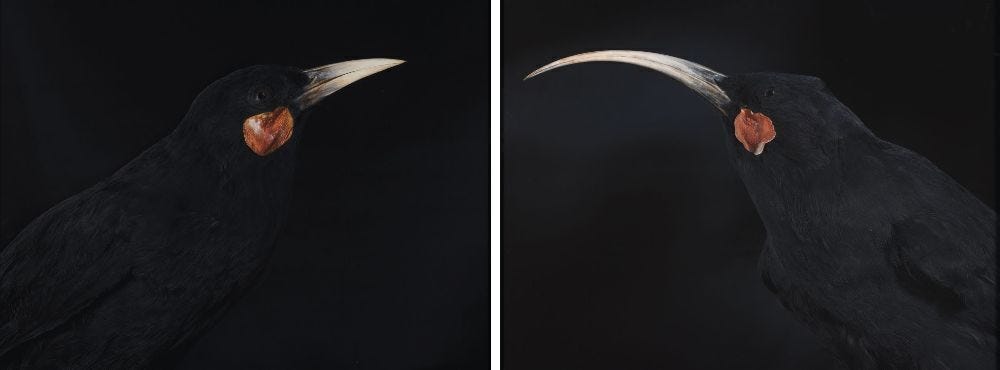
Pardington’s defining works are those of the huia. With almost 60 huia works sold over the last decade, there is enough data to see a real pattern.
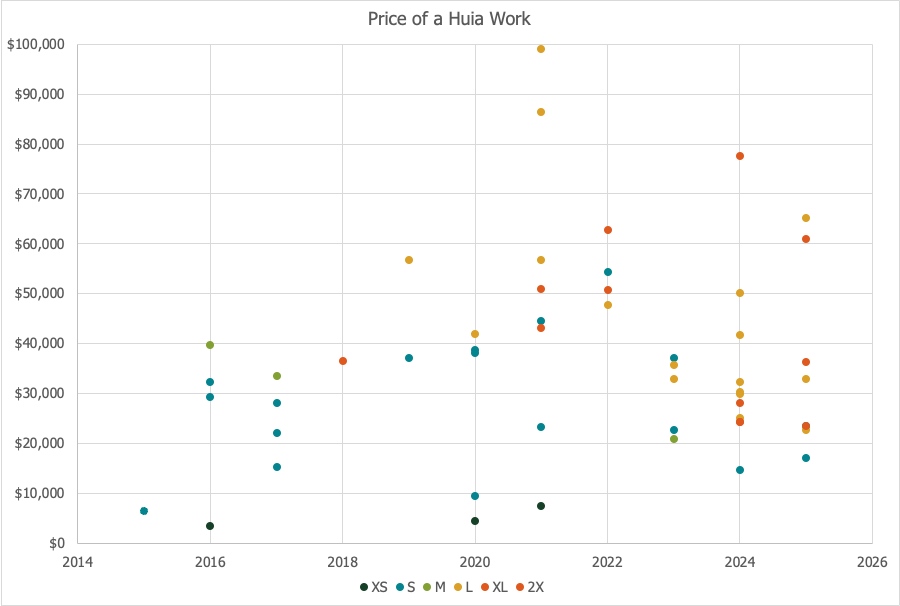
The most obvious point is that larger huia works achieve higher prices than smaller ones. That is expected. But the more interesting point is that the arrival of larger works appears to have changed the way collectors price the smaller ones.
Before the pandemic, smaller huia works would regularly sell above $20,000. Now, with more large works available, smaller huia appear to have been pushed down. A smaller huia today looks to be roughly $10,000 cheaper than comparable works before the pandemic.
That price pressure on huia works has acted in conjunction with a broader slow down across the art market. Prices inflated during the pandemic and have since cooled. That is perhaps most acutely seen in the larger huia works that consistently sold above $40,000, but now most of those works seem to sit in the $20,000 to $40,000 range.
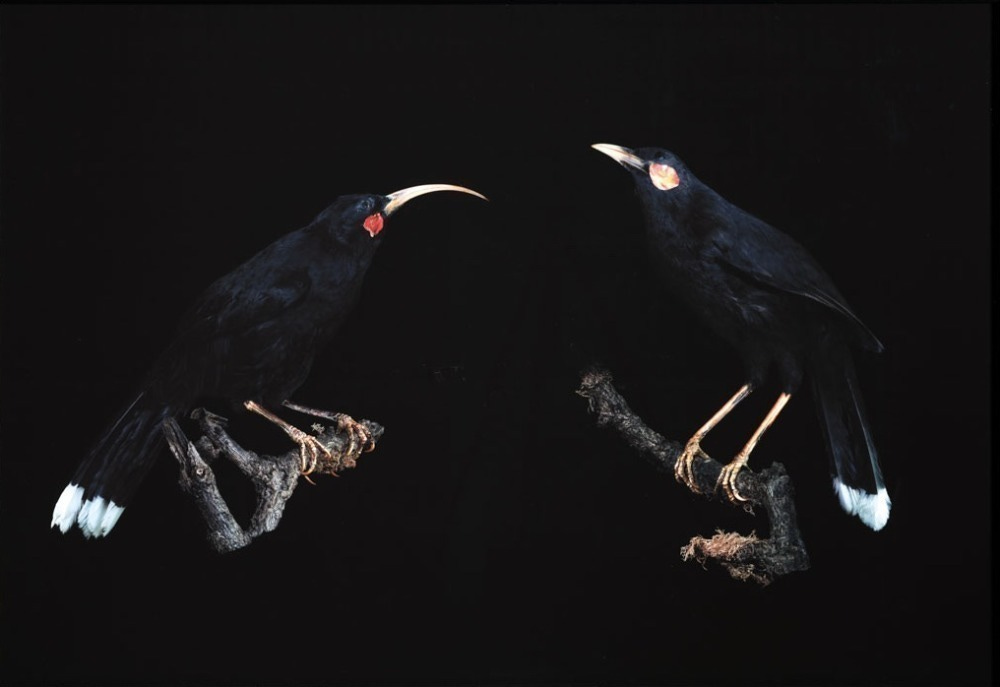
There are exceptions. Collectors still stretch for the best examples. Andrew’s Huia Pair Diptych has held up well. Works where the white feathers are especially visible also appear to attract stronger bidding, with examples such as Ake Ake Huia and Lovers, Timaru, South Canterbury selling well relative to other recent huia works.
My buying view: Personally, I would be cautious above $30,000 for most huia works at auction. There are enough examples that sell at or below that level that your patience is likely to be rewarded. It is also worth remembering that you can buy works directly from her dealer. Pardington is represented by Starkwhite, and some collectors may find better opportunities, or at least more choice, outside auction.
Heitiki
As much as the huia are the obvious trophy works, if I was building a collection and tight on cash, a smarter choice may be one of Pardington’s heitiki works. Admittedly, I didn’t know the difference between a tiki and heitiki, and I suspect others don’t either so here’s a quick lesson:
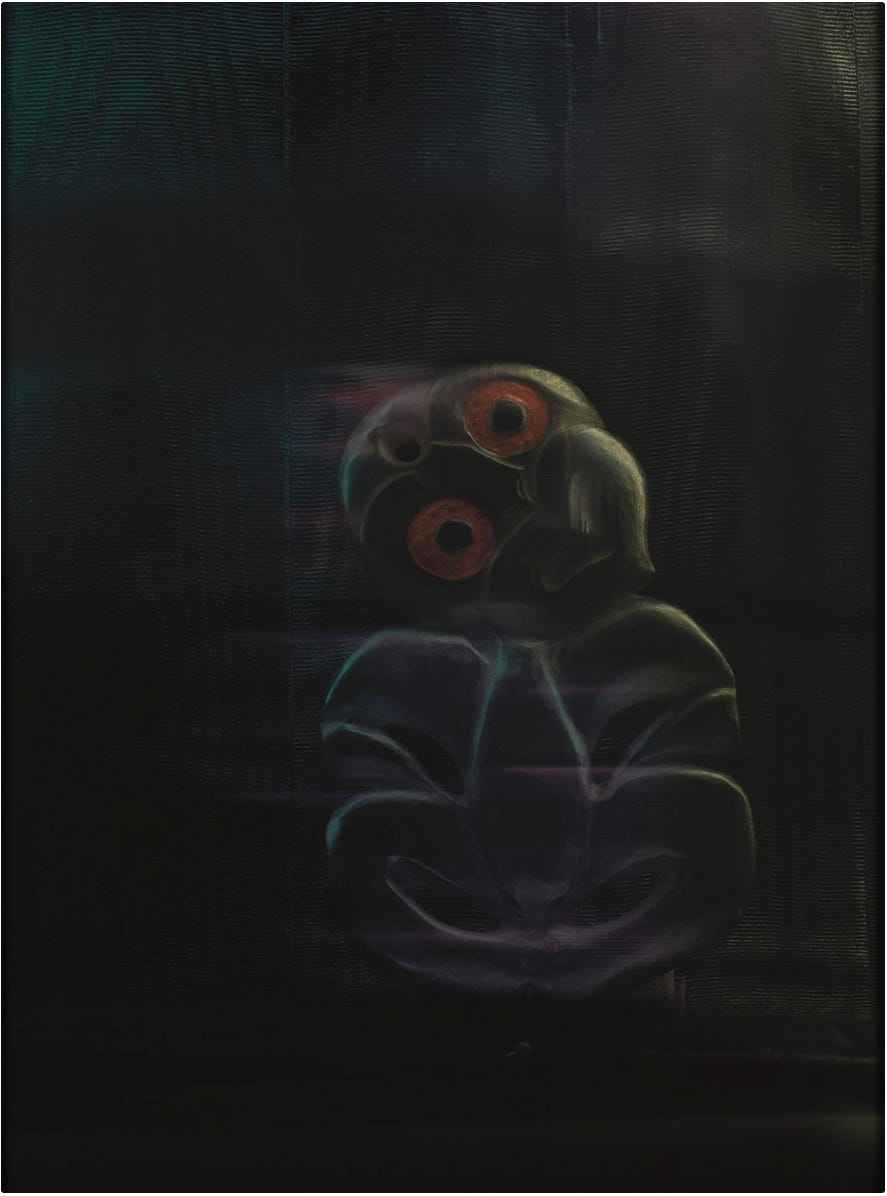
The heitiki is a small, carved ornament, usually of greenstone, worn suspended from the neck. It is often incorrectly referred to as tiki. Tikis are, properly, the much larger human figures carved in wood guarding the entrance to a Maori pa and, also, the smaller wooden carvings used to mark a tapu place.
A record for the heitiki works was set back in 2010 when a set of nine sold for $64,300 and the larger heitiki works now regularly sell for over $25,000. But the smaller works remain much more approachable. Many still sell below $15,000, and a good number sell below $10,000.
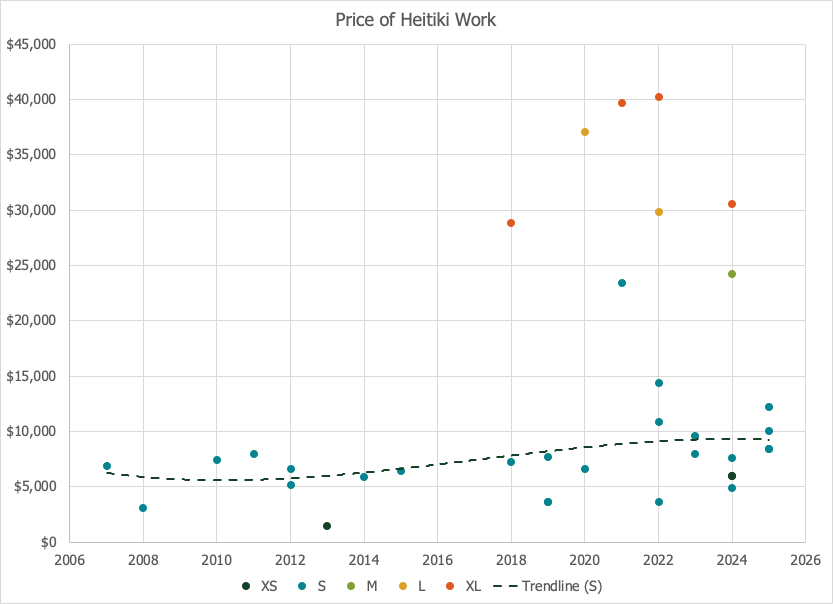
This is where the buying opportunity may sit for those with smaller budgets. The median heitiki price remains far below Pardington’s bird works but the heitiki subject is as integral to Pardington’s practice. It is recurring, recognisable and culturally specific to New Zealand. That combination makes it more compelling than simply buying a lower-priced example from the “Other” category.
Other collectors likely agree, because, analysing just the small heitiki works, the sell-through rate is actually 89%, notably higher than the huia works, and just behind the sell-through of the winged diptychs. That demand is perhaps reflected in the prices of the small heitiki works now nudging up over the last few years.
Conclusion
If you want the blockbuster Fiona Pardington, then chase down a large diptych of the native wings or a strong huia work. Those are the works most likely to be recognised quickly by other collectors and best placed to benefit from any added attention around Venice. The best huia works can sell above $60,000, but I think there are opportunities between $20,000 and $30,000 if you are patient and selective.
At the more affordable end, the heitiki works deserve serious attention. They are integral to Pardington’s practice, visually distinctive and still available at prices that have not run away from collectors. Smaller examples should still be available below $10,000, although that may become harder if broader interest in Pardington continues to build.
The “Other” category in my analysis is mostly earlier photography. Pardington has also worked beyond photography, including the Popular Creator series of ceramic plates and objects, but for this analysis I have focused just on her photographic works.
The median price in 2021 was around $127,000 for the winged diptychs. While I could have plotted this, it would have made the rest of the data points squashed and harder to read.
Her largest single-panel works are often around 180 x 140 cm, which I have labelled ‘XL’. The next size down, usually around 150 x 110 cm, I have labelled ‘L’. Below that, I have treated works around 100 x 100 cm as ‘M’, works under 30 x 30 cm as ‘XS’, and the works in between as ‘S’. The large diptychs are labelled ‘2X’.