
Over the years, New Zealand’s universities have quietly built up some seriously good art collections. Works by Colin McCahon, Frances Hodgkins, Rita Angus, Gordon Walters and Ralph Hotere and others can be found hanging in libraries, lecture buildings and university offices, rather than in the country’s major galleries.
I’ve trawled through six of the collections and picked out the highlights.1 I’ve generally picked the works I think are the most important, but I’ve also included a few that are top-tier works by lesser-known artists or simply personal favourites. We start in Auckland and work our way south to Otago.
University of Auckland
The University of Auckland is home to Elam School of Fine Arts, whose alumni include Don Binney, Gretchen Albrecht and Michael Parekōwhai. The university also has one of the strongest collections on this list, so narrowing it down is challenging.
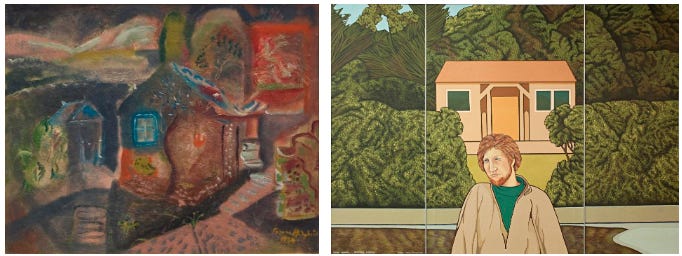
My first pick is Frances Hodgkins’ The Courtyard in Wartime from 1944. Hodgkins painted it at Corfe Castle in Dorset during the final years of the Second World War. It has also appeared in major surveys of her career and comes from the last few years of her life.
Robin White’s Sam Hunt, Bottle Creek is immediately recognisable as her work. Hunt stands outside his cottage north of Wellington, which is painted in that flat, geometric style that became characteristic of White’s work in the 1970s. It is one of four major oil portraits she made of the poet.
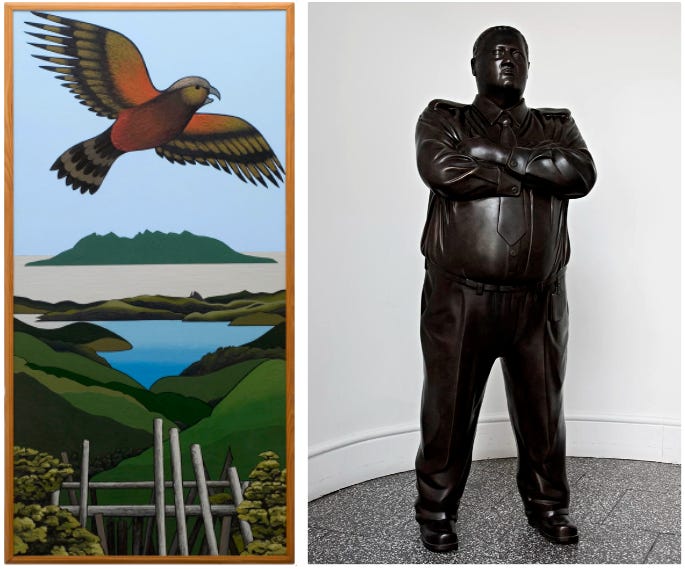
Next is Don Binney’s Arts-Commerce Kākā. A kaka sweeps across the painting above the remains of a kauri dam on Great Barrier Island. This work has an additional university connection as it was made for the Arts-Commerce building. Auckland is not short of Binneys, the university has described its holdings as the largest of any public collection in New Zealand and includes the excellent 1960s paintings Kereru over Wainamu Te Henga and Kawaupaku te Henga.
My final top pick is Michael Parekōwhai’s Kapa Haka. These security guard figures are based on his brother who worked as one. They have been interpreted in various ways, including as commentary on the visibility and authority of Māori workers employed to protect institutions and other people’s property, as well as the disparity in income. There is additional irony with this one cast in bronze (the original ones were in fibreglass).
Other picks include Tony Fomison, -wait!; Colin McCahon, Let us Possess One World; Gretchen Albrecht, Early Morning Rising; Gordon Walters, Painting No. 2; Bill Hammond, Twirl; Michael Smither, Girl with Dolphin; Ralph Hotere, Black Painting and Black Drop; and Milan Mrkusich, Painting (Ochre). I particularly like Northern Shore by Peter Siddell.
University of Waikato
Waikato’s collection has a particularly strong concentration of Māori and Pacific art and its standout work is one of the least conventional works.
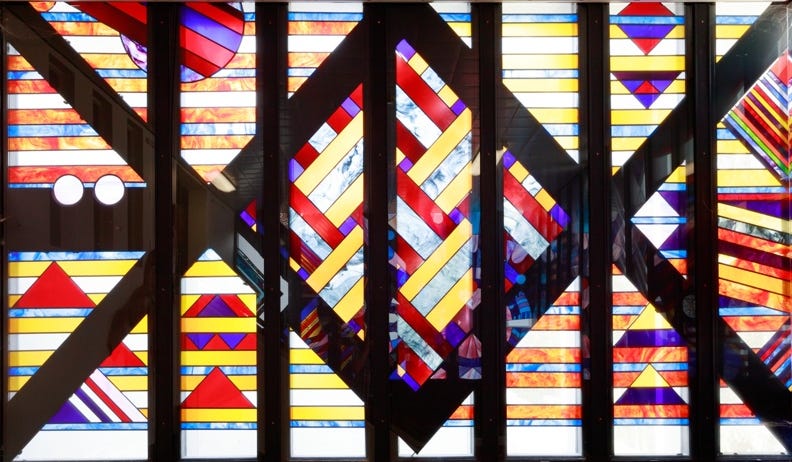
Paratene Matchitt’s Ballantrae Windows is a stained glass installation made up of 27 panels stretching nearly 17 metres. Created in 1987, the imagery moves from the three baskets of knowledge that Tāne brought down from heaven, through the Waikato River, and finally out into the cosmos, complete with the Southern Cross and Halley’s Comet. For several years it was in storage. It was finally reinstalled in the university’s new Pā building in 2024, giving a major work by one of the central figures of Māori modernism a prominent home again.
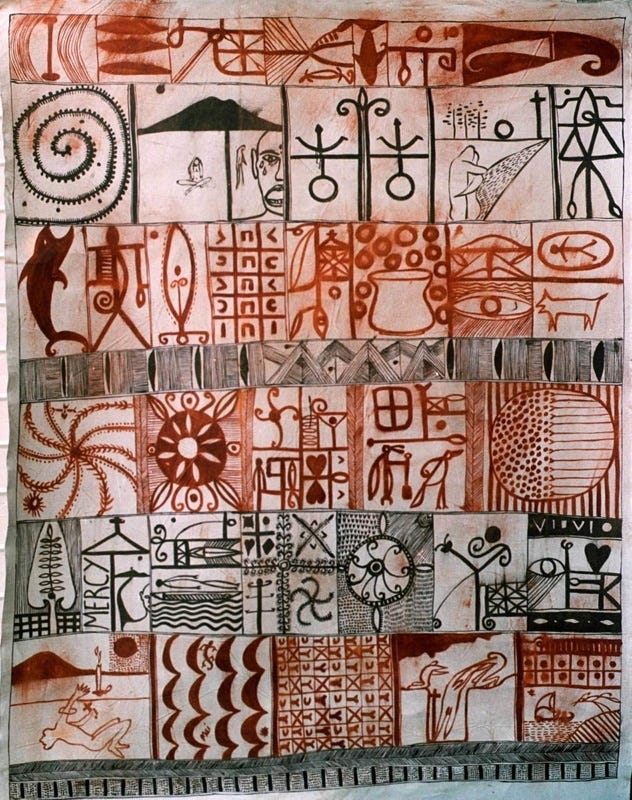
My other pick is John Pule’s Mercy from 1996. Pule was Waikato’s Writer in Residence that year and produced this huge painting while at the university. Mercy brings together the many pictographs that are characteristic of his work.
There is also an extensive collection of works by Max Gimblett, including a group of 22 works on paper he donated to the university for its 50th jubilee. I particularly like In the Beginning was the Word and the Word Became Flesh and Dwelt Among Us.
Other highlights include Brett Graham, Te Matariki; Michael Smither, Harry Drinking (Harriet); Michael Illingworth, Portrait of a Man of Consequence; Paul Dibble, Featherweight; Buck Nin, Patupaiarehe, and Robyn Kahukiwa, Dark Hina.
Victoria University of Wellington
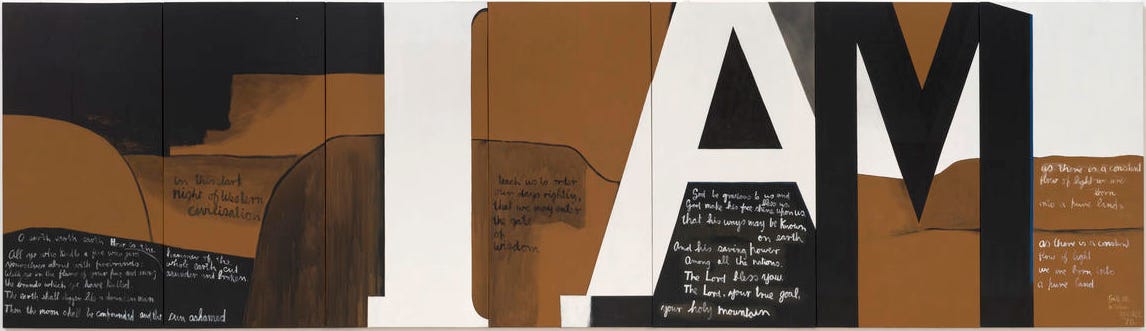
The obvious place to start is Colin McCahon’s Gate III. Painted in 1970, it runs across seven canvases and stretches more than ten metres wide. The work brings together McCahon’s enormous I AM, layered between landscape and biblical text, all colliding in what the Adam Art Gallery describes as the standout work in the university collection. It was originally made for the 1971 exhibition Ten Big Paintings at Auckland City Art Gallery. VUW bought it the following year. If there is one work in this article that could make a claim to being the most important of McCahon’s paintings, this is it.
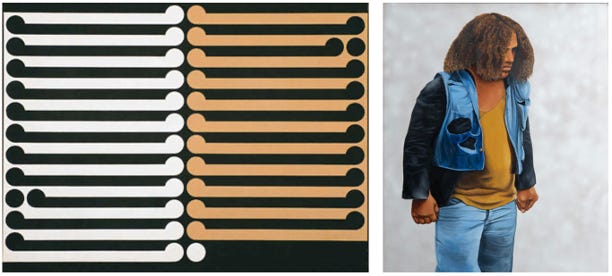
I’d also pick Gordon Walters’ Kahukura from 1968. Walters had only unveiled his mature koru paintings publicly two years earlier, so this comes from very early in the body of work that would come to define his career. The koru forms appear deceptively simple, but the black and the white/ochre colours continually swap between foreground and background as you look at it.
I also particularly like Robyn Kahukiwa’s The Outcast. There are more important Kahukiwa works in the collection, but this is one of several works painted during her time teaching at Mana College that captures the challenges of young, urban Maori. A similar work, Girl in a Bush Shirt, was recently acquired by Christchurch Art Gallery.
Also worth a look are Frances Hodgkins, Kimmeridge Foreshore; Ralph Hotere, Song Cycle: The Voyage; Jacqueline Fahey, The Birthday Party; Don Binney, Tabernacle; Michael Smither, Christ Driving the Money Changers from the Temple; Colin McCahon, Agnus Dei, Donna Nobis Pacem; Richard Killeen, Welcome to the South Pacific; Frances Hodgkins, The White Chateau; and Philip Clairmont, The Bed.
University of Canterbury
Canterbury occupies a unique place in New Zealand art history. Generations of artists studied or taught at the Canterbury College School of Art and its successor, Ilam, while many were also associated with The Group, the influential Christchurch collective that became a leading showplace for New Zealand art. Canterbury and the surrounding landscape also provided the subject for many iconic New Zealand paintings, including works by my two top picks, Bill Sutton and Rita Angus.
Bill Sutton’s The Four Seasons – Summer is one of four paintings in Sutton’s Four Seasons series, completed between 1968 and 1970. The quartet is now split up. Autumn is at Te Papa, Winter at Christchurch Art Gallery, Spring at the Christchurch Club and Summer remains at the university.

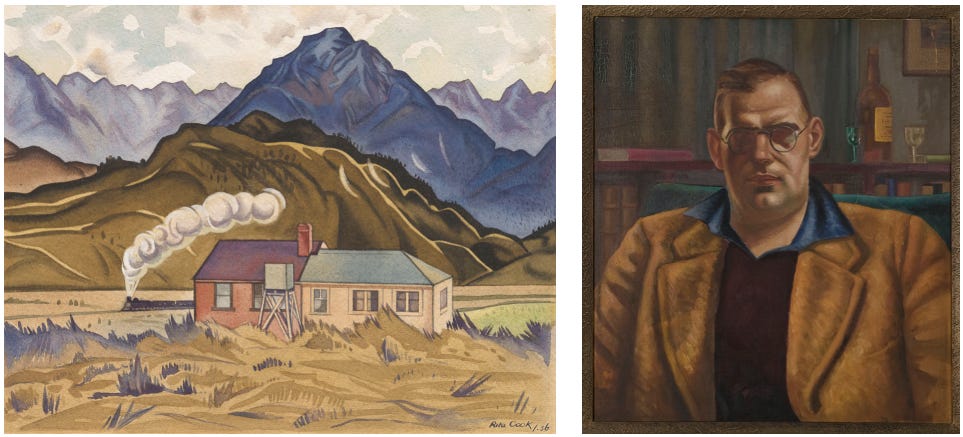
My next pick is Rita Angus’ Untitled [Mountain Biological Station, Cass] from 1936. Angus spent ten days at Canterbury’s field station at Cass with Louise Henderson and Julia Scarvell, producing works of the surrounding mountains and railway settlement. Angus’ iconic Cass painting was a direct result of that trip, painted in her studio from the studies she made.
Not as significant as the above two paintings, but I think a great example of his work, is Leo Bensemann’s Portrait of Alan Danks. Bensemann was a central figure in the Christchurch art world and Canterbury owns more than 100 of his works. The subject of the painting is Canterbury economics professor, Alan Danks, whose somewhat questionable claim to fame is leading the committee whose recommendations led to the Official Information Act. Regardless, he certainly has one of the best university portraits I’ve seen.
Other highlights include Bill Sutton, Landscape Synthesis XII; Russell Clark, The Family Group; Neil Dawson, Lit LeWitt; Leo Bensemann, Takaka; Raymond McIntyre, Portrait of a Young Girl; Bill Hammond, Snare; Jude Rae, Still Life 6; and Darryn George, Waiata – Psalm 121.
Lincoln University
Lincoln’s collection is much smaller — a little over 300 works — but there are some excellent paintings hiding in it.
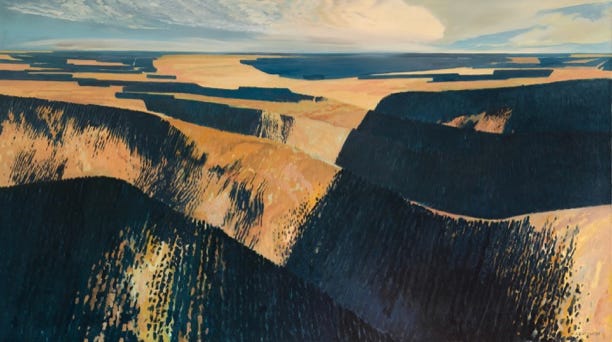
The standout is Bill Sutton’s Plantation Series XVIII from 1988. Lincoln itself has called it “undoubtedly the star of the Collection”. At almost two-and-a-half metres wide, it is also hard to miss. It’s a commentary on the changing landscape as Sutton was dismayed by the spread of dark radiata pine plantations across the Canterbury plains. This became the theme for one of the major late series of his career.
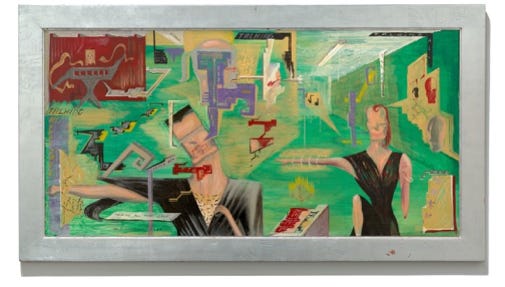
My other pick is Bill Hammond’s Talking All That Jazz from 1989. The date is interesting as it was the year Hammond travelled to the Auckland Islands, where he became fascinated by a landscape once dominated by birds and largely untouched by humans. The trip triggered the bird-human paintings for which he is now best known. Talking All That Jazz sits right around that turning point. It still has something of the manic energy of Hammond’s earlier paintings, before his strange avian world completely took over.
I’ve also included Claudia Kogachi’s Just Girly Things. It is a recent acquisition rather than an established masterpiece, but I like Kogachi's work and think she shows great promise. Gow Langsford began representing her last year and held her first solo exhibition with the gallery earlier this year.
Other highlights include Llew Summers, Joy of Living; Michael Smither, Rocks and Butterfly, Rakaia River; Shane Cotton, Tika; and Robyn Kahukiwa, Still Māori and Comely.
University of Otago
That brings us to our final university, Otago. The Hocken Collections is on a different scale to most of the other university collections, with tens of thousands of artworks and an important archive of New Zealand art and artists.
Its great prize is Colin McCahon’s The Wake. Painted in 1958, it runs across 16 unstretched canvases and incorporates a poem by McCahon’s friend John Caselberg. The work was designed to surround the viewer rather than behave like a conventional painting hanging neatly on a wall. It came at a pivotal moment. McCahon had recently returned from his first trip to the United States, where he had seen large scale modern American painting firsthand. The Wake is appropriately ambitious as a result.

And it is far from the Hocken’s only McCahon. The collection holds more than 200 works by him, as well as a huge archive of papers, sketches and working material. The Virgin and Child Compared, I Am and Northland Triptych are among the other paintings worth finding.
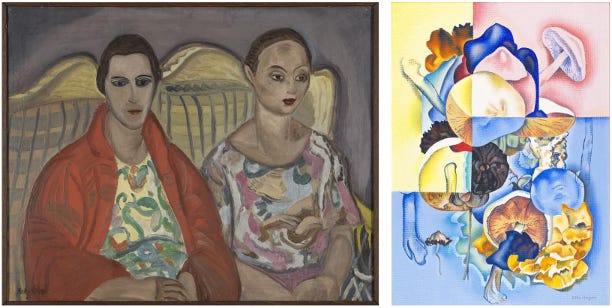
Frances Hodgkins’ Friends (Double Portrait) is another exceptional work. Painted in the early 1920s, it depicts Hodgkins’ former pupils and friends Hannah Ritchie and Jane Saunders. Its elongated figures show how far Hodgkins had moved from the relatively conventional watercolours of her earlier career and towards European modernism. The work later belonged to poet and collector Charles Brasch, whose bequest transformed the Hocken collection.
My third pick is Rita Angus’ Fungi. Instead of the portraits and sharply defined landscapes most associated with Angus, in this work a group of mushrooms is transformed into a collection of strange, almost abstract forms.
Hotere’s Rain is worth a special mention. Made from three five-metre-high painted banners, it incorporates words from Hone Tuwhare’s poem of the same name. Unlike a lot of the art buried in university storage, it can still be seen in the Hocken foyer.
Other highlights include Rita Angus, Self Portrait; Robin White, Clouds, Hill and Claudia; Jacqueline Fahey, Sisters Communing; Doris Lusk, St Bathans; Ralph Hotere, Rain; and Shane Cotton, Back Words.
AUT and Massey University are not included because I couldn't find a searchable public catalogue for either collection.
I used to stare up at a huge Binney while waiting for my lecture to start at Vic. We were very lucky students