
Overview
Over the past decade, Australian female artists have built a market defined by breadth and depth. Unlike the men’s market, where Brett Whiteley’s dominance reshapes the distribution, the female market is led by a cluster of artists rather than a single overpowering figure.
I reviewed the top 20 artworks from each year from 2015 to 2024. 200 artworks in total. Across the decade, 34 female artists appear at least once.
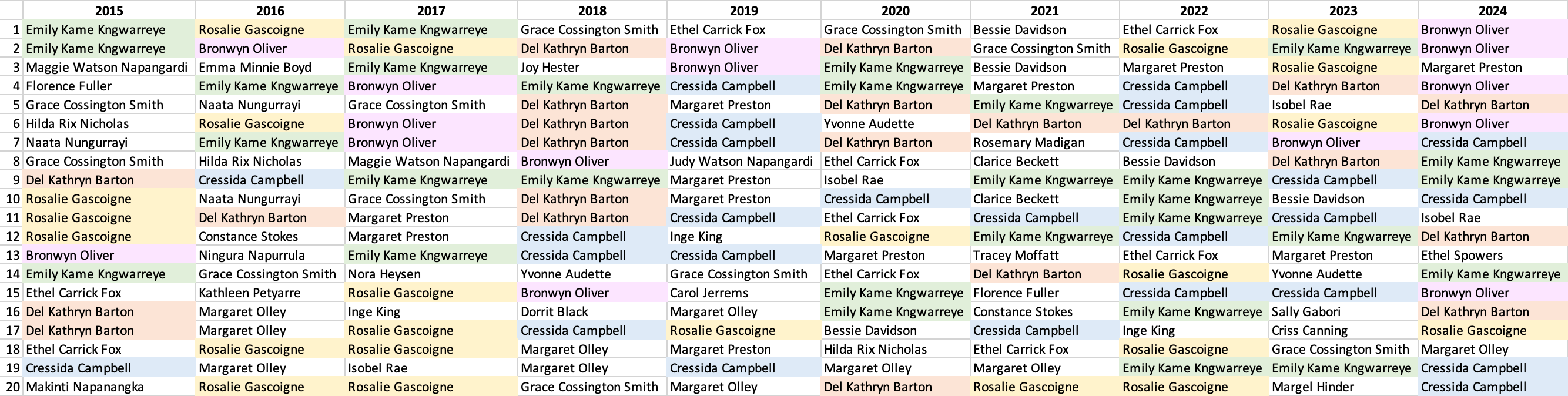
Four broad groups shape this landscape:
Pioneering modernists, whose early modern works established new approaches to colour and form with enduring demand at the top end.
Post-war and late-20th-century artists, who broaden the middle of the market.
Contemporary voices, who have risen into the top tier while competing against a deep field of established names.
Aboriginal artists, a category dominated by Emily Kame Kngwarreye but still central to the Australian auction market.
Rather than being driven by a single artist, period, or style, results are spread across multiple generations. Within that broader mix, however, five artists in particular stand out as consistently shaping the female auction market over the past decade.
The Core Five
At the centre of the market are five artists who define the shape of the last ten years:
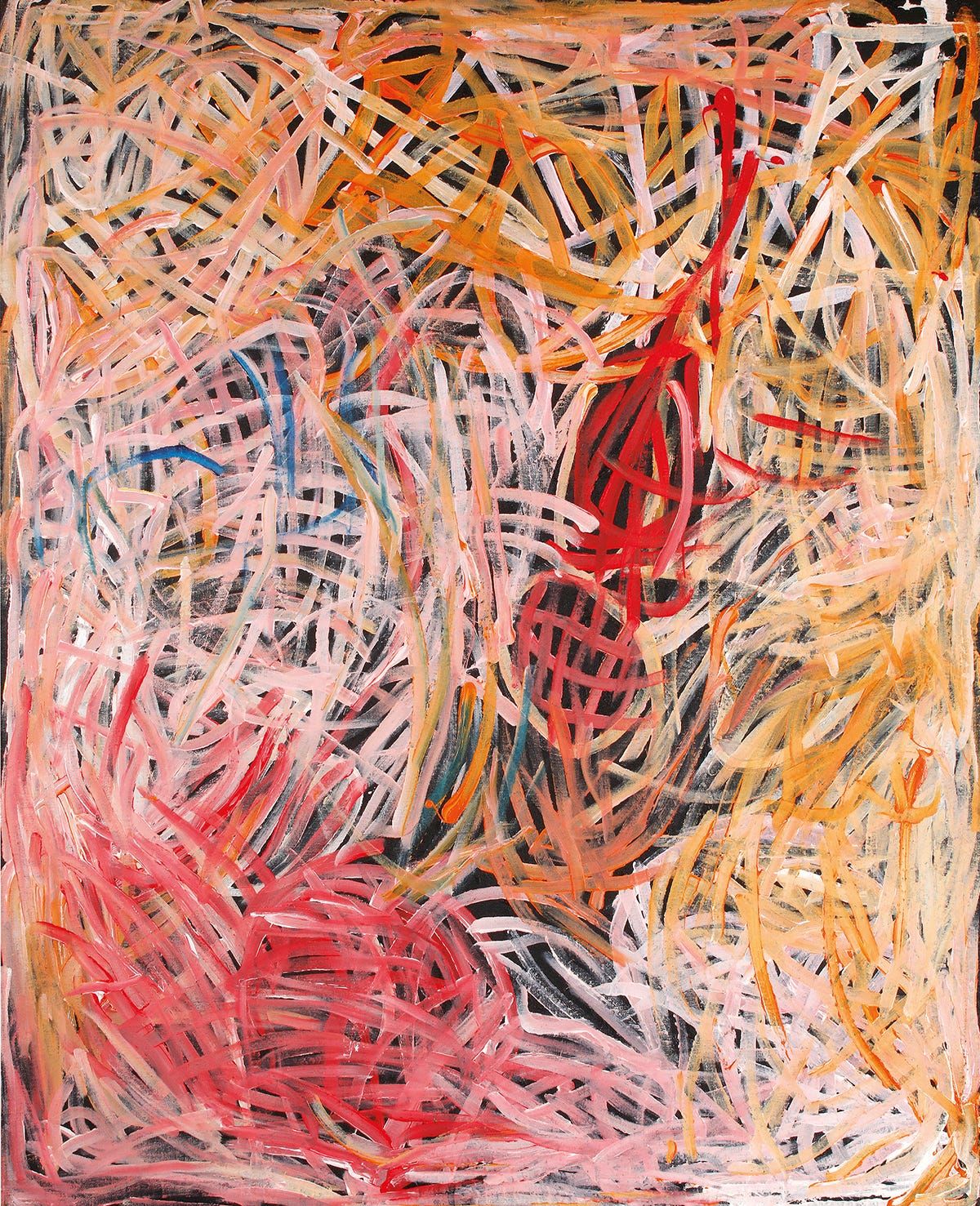
Emily Kame Kngwarreye (1910-1996) leads with 29 appearances in the top 200 and $12.2m in total auction sales over the 10 years and has the highest volume of works at auction. Her paintings translate ancestral knowledge and desert ecologies into expansive, gestural compositions that sit comfortably alongside Western abstraction while remaining grounded in Aboriginal cultural tradition.
Cressida Campbell (b. 1960) is close behind with 26 appearances and $9.6m in sales. Her single-edition woodblock works, rooted in interiors and still life, combine technical discipline with scarcity, supporting a sustained presence at the top end of the market.
Rosalie Gascoigne (1917-1999) has 23 appearances and $8.5m in sales, averaging about $170k per work. Her assemblages use weathered found materials, from road signs to soft-drink crates, to create carefully structured works that evoke landscape through colour, rhythm, and texture.
Del Kathryn Barton (b. 1972) (22 appearances and $7.6m in sales) combines dense mark-making with figurative imagery drawn from nature, psychology, and mythology, producing highly worked paintings that have consistently placed her among the top performers at auction.
Bronwyn Oliver (1959-2006), with fewer works (15 appearances) but higher value, has achieved $6.7m and one of the highest averages ($269k) of all. Her sculptures combine organic form with rigorous structure, using hand-worked metal to create complex surfaces with limited supply driving consistently high prices at auction.
Together, these five account for the majority of the female market, but importantly, none overshadows the rest.
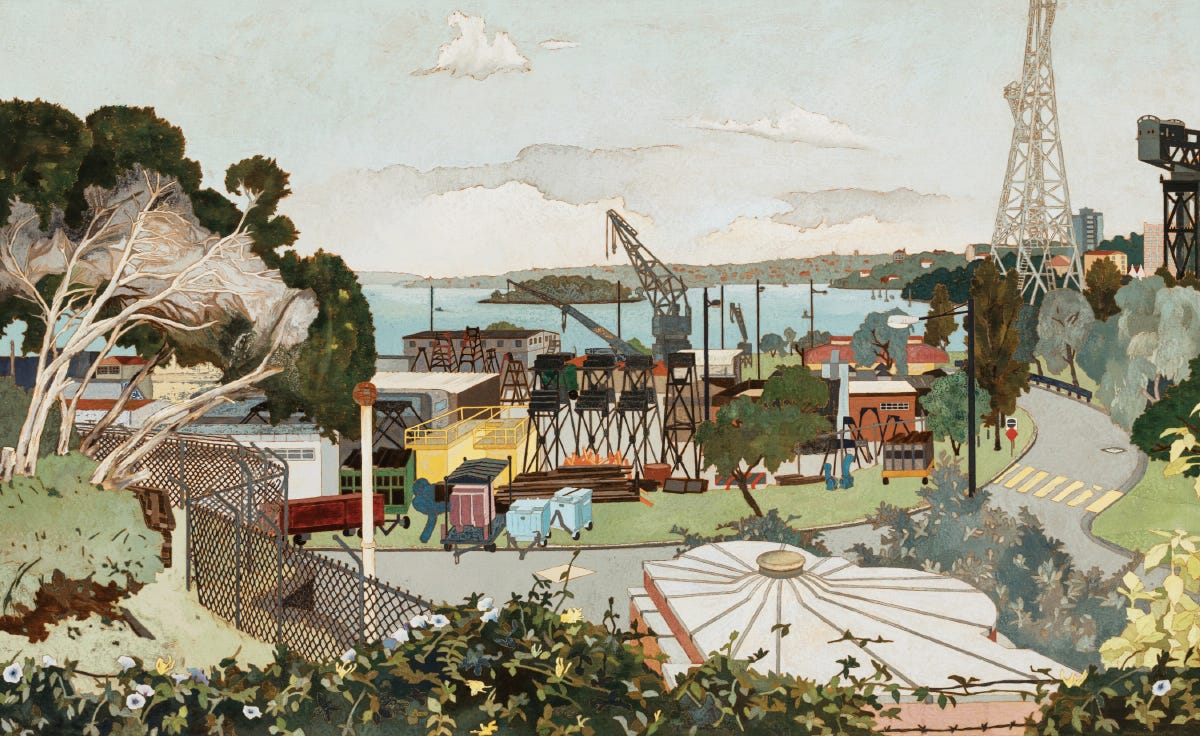
These Core Five and many of the other top artists fall into the following four groups:
Pioneering Australian Modernists
A second tier of early modern names, born in the 1800s, show the lasting value of pioneering Australian women:
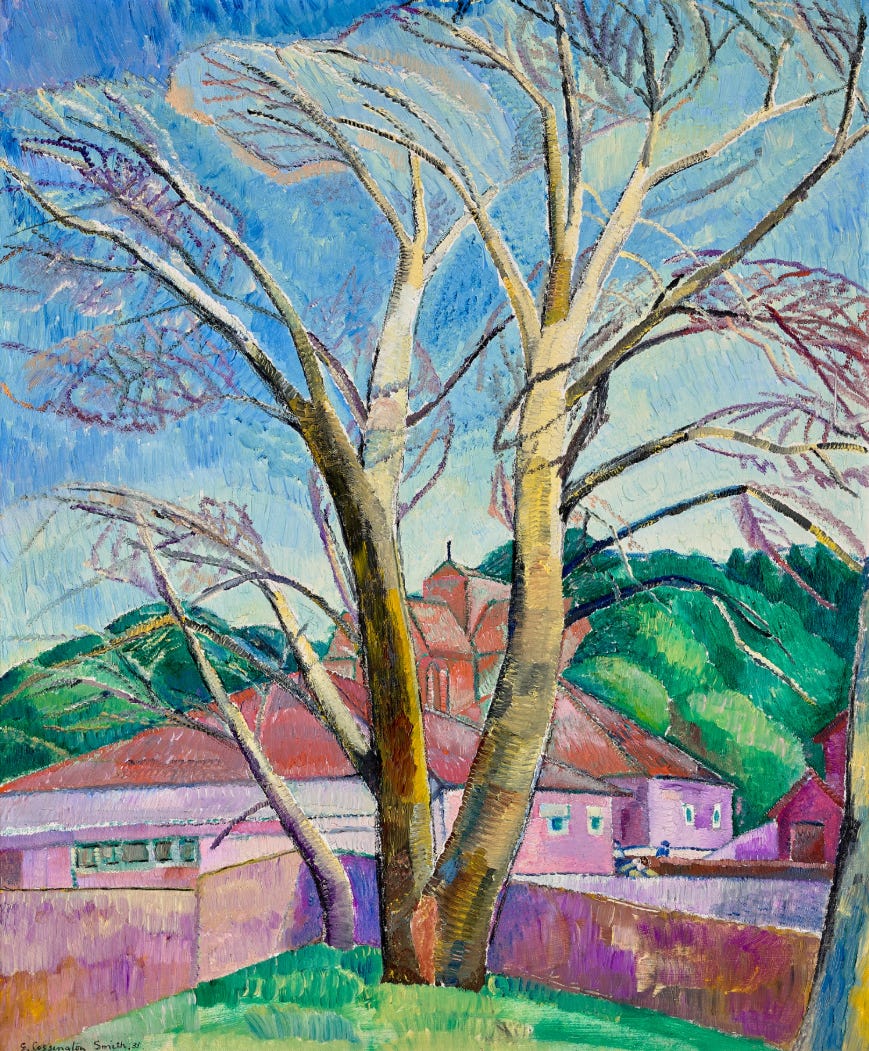
Grace Cossington Smith (1892-1984) has achieved $5.0m in sales across 12 appearances in the top 200. An early pioneer of Australian modernism, she drew on post-impressionist ideas to transform domestic interiors and Sydney city life into vibrant, light-filled compositions.
Margaret Preston (1875-1963) has recorded $6.7m in sales with 11 appearances, underpinned by strong demand for both paintings and prints. Her bold still lifes and woodcuts of native flora helped define a distinctly Australian approach to modern art.
Ethel Carrick (1872-1952) has $5.1m in sales and 8 appearances in the top 200. Her bright, post-impressionist paintings of European street scenes, markets, and floral subjects are defined by bold colour, lively brushwork, and a strong sense of light and movement.
Bessie Davidson (1879-1965) has appeared 6 times in the top 200 from just 24 sales that generated $2.8m in sales, averaging $117k per work. Her refined interiors and portraits explore domestic life through rich colour and expressive, painterly surfaces shaped by her long Paris career.
Clarice Becket (1887-1935) only appears twice in the top 200 but has $5.1m in total sales and average $67k per work, putting her on par with the other artists above. Her understated paintings of beaches, streets, and twilight scenes distil light and weather into calm, contemplative compositions.
Post-War Australian Modernists
The post-war generation presents a compelling bridge between the pioneering modernists and the contemporary names. Aside from Rosalie Gascoigne (already mentioned above), they do not dominate the rankings, but they add breadth and continuity across the periods:
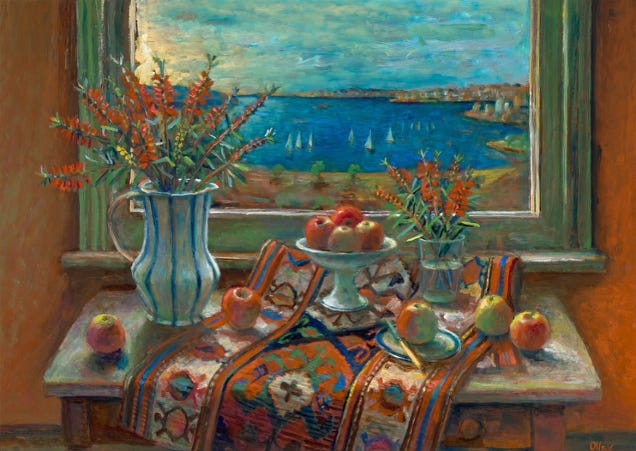
Margaret Olley (1923–2011) is best known for her vibrant still lifes and interiors, transforming the everyday objects of her home and studio into richly layered, intimate compositions.
Yvonne Audette (b. 1930) is known for abstract paintings built from layered marks and calligraphic lines, using restrained colour and surface texture to create a strong sense of structure and rhythm, and continues to gain momentum at auction.
Inge King (1915–2016) created abstract steel sculptures exploring organic and planetary forms, often realised at a monumental scale in public spaces. Her major works are rare and priced accordingly.
Rather than forming a single stylistic school, these artists span different practices and materials, providing continuity between the pioneering modernists and today’s contemporary market.
Contemporary Drivers
What stands apart the female market is the strength of its post-1945 cohort. Unlike the male market, where contemporary names appear but rarely dominate, the female side is led by artists whose influence remains active today.
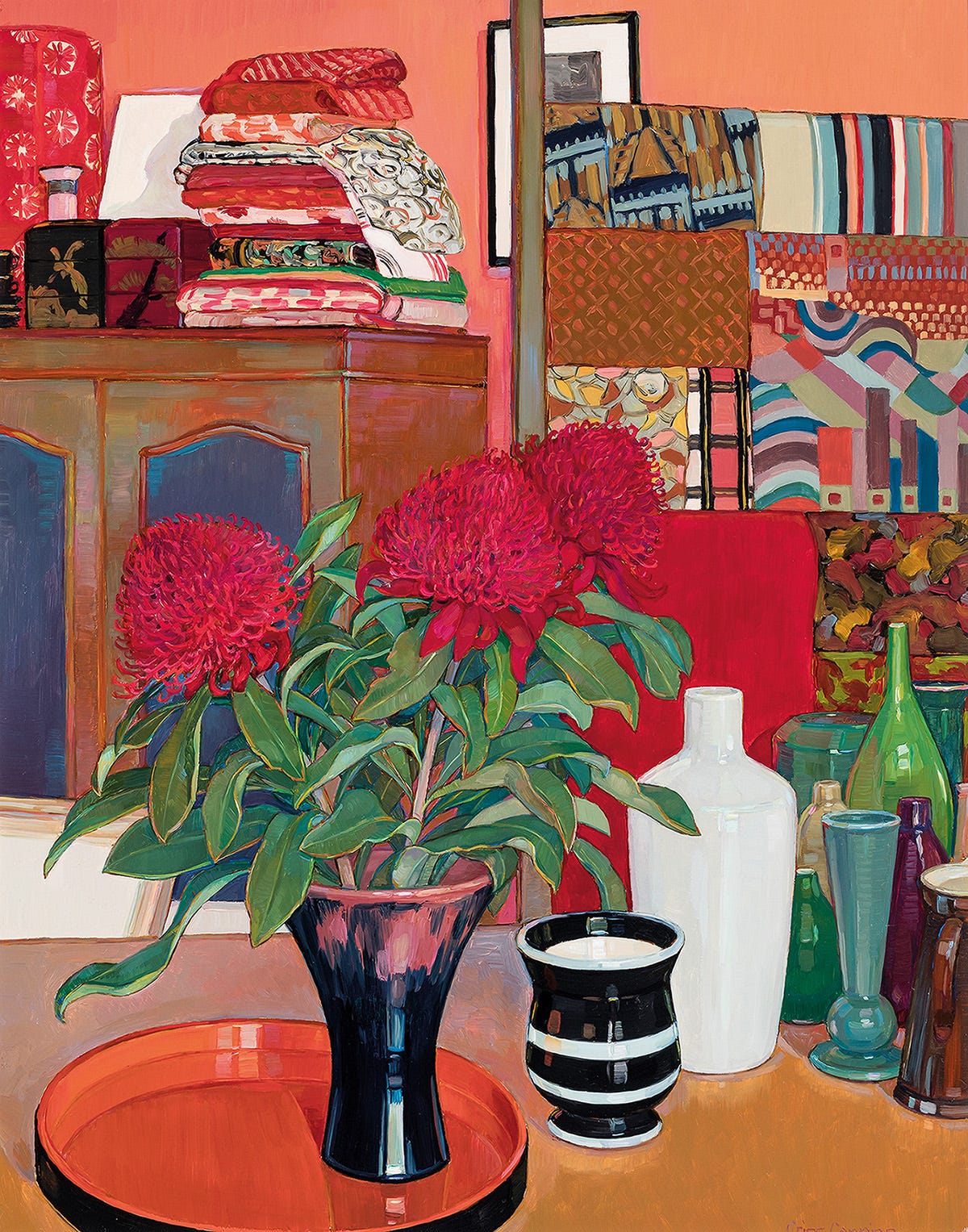
Beyond the key figures already mentioned (Del Kathryn Barton, Cressida Campbell, Bronwyn Oliver), artists such as Criss Canning, Tracey Moffatt, and Carol Jerrems contribute to the contemporary depth of the market. Canning, in particular, has shown strong momentum over the past five years, with rising prices and increasing momentum.
This contemporary weight makes the market feel more future-facing than its male counterpart.
Aboriginal Presence
Emily Kame Kngwarreye is such a significant figure in Australian art that she leads the female market by volume, total sales, and record prices. Given the prominence of Aboriginal art in the Australian auction market more broadly, I expected to see a wider group of female Aboriginal artists appearing regularly in the annual top-20 results. In practice, however, representation at this very top end remains narrow.
The next most visible names over the decade are:
Sally Gabori is the next most significant name Aboriginal name, but with $1.8m in sales and averaging only $31k per work, she lacks the impact of the other artists listed above, but momentum in prices for her works continues to build.
Naata Nungurrayi and Maggie Watson Napangardi are two other artists worth knowing, each had 2 works in the top 200, but that was near the start of the 10 years analysed, while the volume of works coming to auction is limited and their sales sit below $1m.
Kngwarreye’s dominance therefore reflects a concentration of top-tier auction results, rather than a lack of significance among other female Aboriginal artists. At the very highest price levels tracked here, her market position is exceptional both within Aboriginal art and across the Australian auction market as a whole.
Price Trends
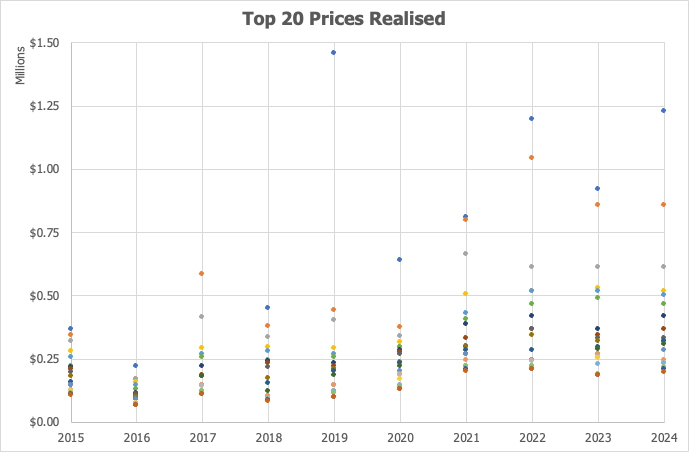
Finally, a brief look at prices. The chart below plots the prices of the top 20 female artworks each year, highlighting how both the ceiling and the floor have evolved over time.
Some key observations:
The entire price range has shifted upward. From 2020 onward, the whole top-20 cluster sits materially higher than in the mid-2010s.
The price floor has risen meaningfully. Works ranked 15–20 now achieve prices that would have sat mid-table earlier in the decade.
The women’s results show a tighter price band. Compared with the men’s market, prices cluster more closely, with fewer extreme highs pulling the distribution apart.
A price gap remains at the very top. Even with increased focus on women artists, male top-20 works consistently exceed $500k and are edging beyond $800k, while most female top-20 works still transact below $500k
Big Picture
The Australian female auction market is led by a group of artists rather than a single dominant figure. The “Core Five” (Kngwarreye, Campbell, Gascoigne, Barton, Oliver) sit at the centre of the market, but no one artist overwhelms the rest. Alongside other key figures, they fall into four broad groups discussed above:
Pioneering modernists, who underpin long-term cultural value
Post-war modernists, who broaden the middle of the market
Contemporary drivers, who shape its forward momentum
Aboriginal presence, led overwhelmingly by Kngwarreye
Auction results on the female side are spread across a wider group of artists, supported by ongoing production from living artists, continued institutional attention, and limited supply in markets such as Oliver’s. Together, these factors help explain the consistency seen at the top end over the past decade.
Methodology
As usual, I’ve taken auction results from Smith & Singer, Deutscher and Hackett, Menzies, Bonhams, and Leonard Joel. I’ve also included the two results we previously covered for Emily Kame Kngwarreye from Art Leven (formerly Cooee Art) that featured in our top 10 recently.
The full list of artists and appearance from the top 200 results:
Core Five: Emily Kame Kngwarreye (29); Cressida Campbell (26); Rosalie Gascoigne (23); Del Kathryn Barton (22); and Bronwyn Oliver (15)
Historic Anchors: Margaret Preston (11); Grace Cossington Smith (11); Margaret Olley (10); Ethel Carrick (9); Bessie Davidson (5); and Isobel Rae (4)
Two or Three Appearances: Yvonne Audette (3); Hilda Rix Nicholas (3); Naata Nungurrayi (3); Inge King (3); Florence Fuller (2); Maggie Watson Napangardi (2); Clarice Beckett (2); and Constance Stokes (2)
One Appearance: Sally Gabori; Ethel Spowers; Ningura Napurrula; Judy Watson Napangardi; Tracey Moffatt; Kathleen Petyarre; Carol Jerrems; Makinti Napanangka; Nora Heysen; Criss Canning; Rosemary Madigan; Emma Minnie Boyd; Dorrit Black; Joy Hester; and Margel Hinder
The women’s rankings show a long tail of artists with one or two appearances, contributing to greater diversity at the top end. Partly because of this, I’ve also taken into consideration the total amount of sales over this time period to ensure proper representation by those women who have just one or two appearances in the top 20 but play a significant contribution to the auction market.