
These are three artist snapshots from the 2025 Australian Fine Art Auction Market Report. A comprehensive, data-driven review of the year’s key results, trends, and pricing signals. Highlights from the report were previously covered here. The article has been extended with a look at how these artists have fared at auction in the first six months of 2026.
Criss Canning
A distinctive still-life practice with growing collector appeal
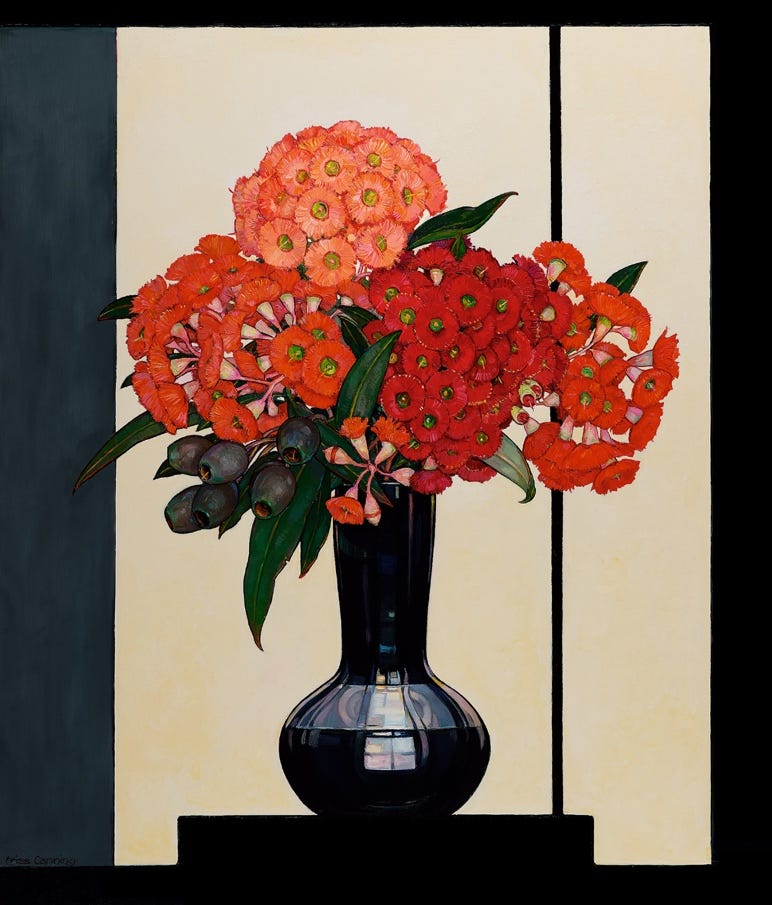
Born in Melbourne in 1947, Criss Canning has built one of the most distinctive still-life practices in Australian painting. She is best known for paintings of flowers and domestic objects, often drawn from daily life at Burnside, the 19th-century home she shares near Ballarat with her husband, horticulturalist David Glenn.
Canning’s paintings are immediately recognisable for their saturated colour, shallow depth, and carefully structured arrangement of objects. She has described her process as beginning with an internal pull toward a particular colour, then building the composition piece by piece, completing each element before moving to the next. The result is a distinctive tension between stillness and intensity.
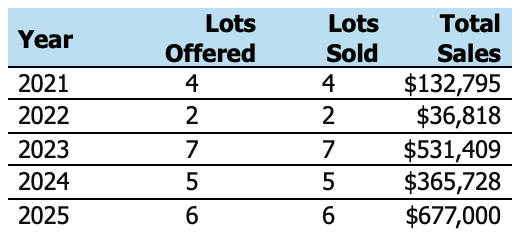
In recent years, demand for Canning’s work has continued to grow, achieving perfect sell-through rates over the last 5 years. Further, her average price continues to grow: the average price in 2019 was just $9k, growing to $76k in 2023, and now $113k in 2025.
This is driven in part by increasing top prices for her works. The 2023-2025 period contains multiple step-change results at auction (all at Smith & Singer): In May 2023, Waratah and Studio Detail sold for $98,182 off a $25,000–35,000 estimate band, demonstrating sharp demand for Canning’s still lifes. In December 2023, Native Flowers from Pomonal sold for $227,045 setting an auction record at the time, more than doubling the previous record. Then in November 2025, Gum Blossom from Pootilla sold for $405,000, setting a new auction record.
At the same time, the market still offers genuine entry points, especially via editioned prints and smaller works. For example, a small oil on board, Gum Blossoms in Vase, sold at Leonard Joel for $5,750 in 2025 and prints have sold in earlier years for between $500 - $1,500.
Canning’s market strength reflects more than rarity or record prices. It also reflects growing demand for her distinctive visual language, within a market that has recently shown strong interest in still life and domestic interior works more broadly.
Howard Arkley
Electric suburbia and domestic interiors drive record prices
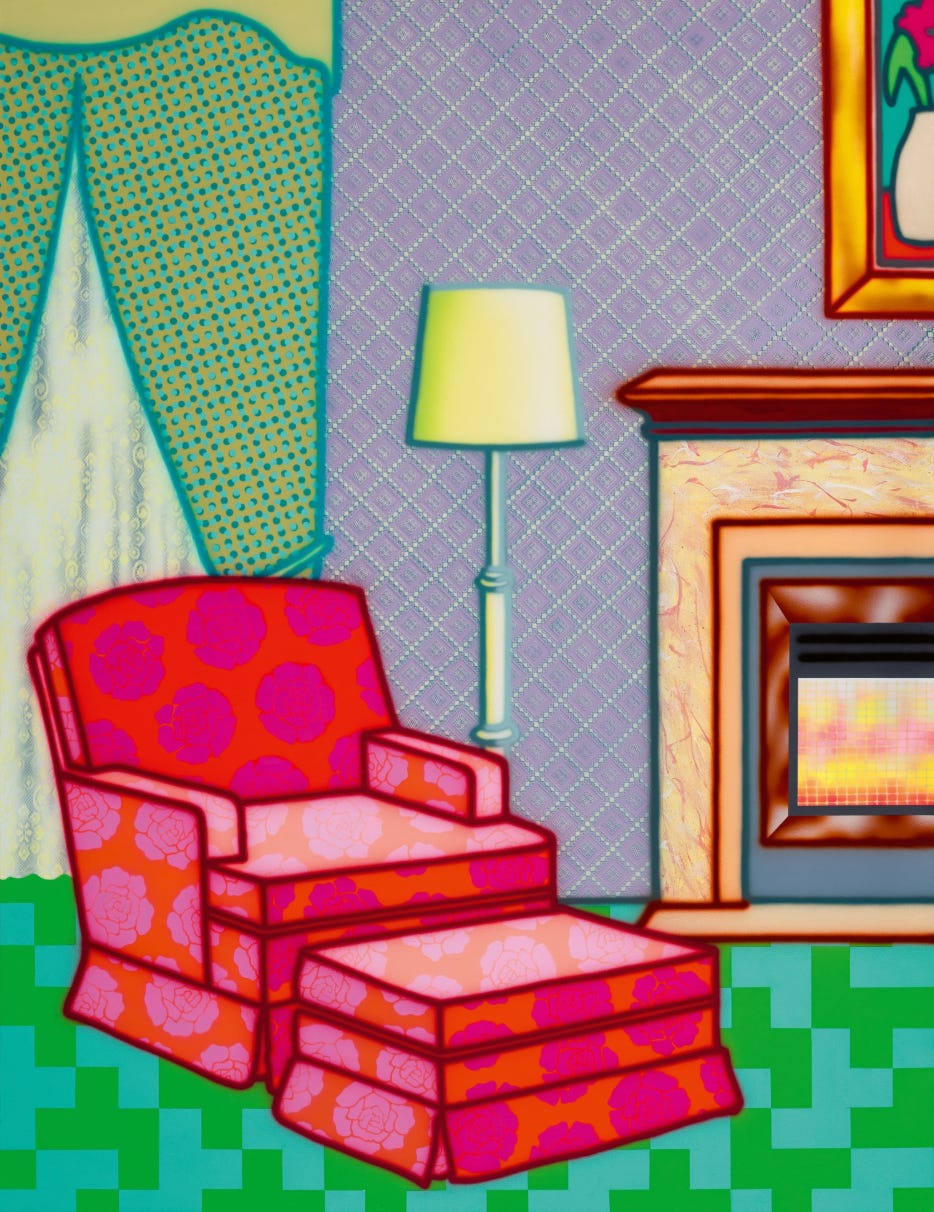
Howard Arkley (1951–1999) was a leading Australian artist whose vividly airbrushed suburban landscapes defined a new visual language in contemporary art. His work was heavily influenced by the 1970s and 1980s world of pop art, fashion, feminism, punk music, and the club scene. Those influences transformed the aesthetics of everyday architecture, lounge rooms, and freeways, into psychedelic compositions rich with colour and pattern that propelled him and suburban life into the spotlight of Australian visual culture.
He rose to prominence in the 1980s and 1990s with key institutional support, culminating in his selection for the Australian Pavilion at the 1999 Venice Biennale. Though his sudden death later that year cut short a rising international career, his influence endured. Museum exhibitions, books, and growing collector interest have continued to affirm his place in Australia’s art canon.
In 2025, Arkley’s auction market saw a breakout year. Twelve works sold for a combined $10.5 million, a dramatic leap from $559k in 2024 and the strongest result ever recorded for the artist. While the number of lots offered was modest, demand was intense. New records were set with Contemporary Units and Neapolitan Delight each selling for about $2.5m, well above their estimates. Another two works sold around the $2m mark.
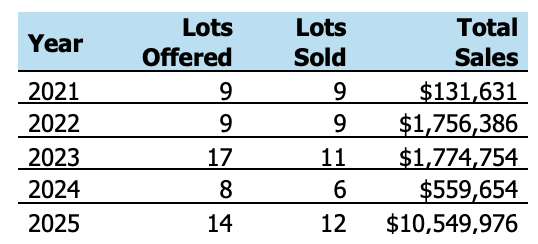
This suggests a recalibration at the high end of his market. Arkley’s domestic interiors painted in 1992 and 1993 are particularly in demand commanding six and seven figure prices, followed closely by exteriors of suburban homes that he painted mostly in the late 1980s. With his early death there is a limited supply of works that has pushed prices up, but he did produce a few screenprints that offer a more accessible entry point, eg. Triple Fronted that sold for $25k in 2025 as well as some larger editions released by his estate that sell for around $3k.
Already subject of multiple exhibitions and retrospectives, these results confirm Arkley’s position as one of Australia’s most important contemporary artists. A visionary who turned suburbia into spectacle, and whose secondary market now echoes his lasting cultural significance.
Albert Namatjira
Central Australian landscapes and a lasting legacy
Albert Namatjira (1902–1959) was a Western Arrernte artist best known for his watercolour landscapes of Central Australia. Unlike most Aboriginal artists, Namatjira adopted a Western watercolour style. His success helped establish what became known as the Hermannsburg School, which has continued across multiple generations in the Hermannsburg / Ntaria region.
His images of gum trees, mountain ranges, gorges, and creek beds became iconic representations of Central Australia for many Australians. More recent scholarship has increasingly re-evaluated his paintings as works that, while using a Western medium, convey a distinctly Aboriginal relationship to Country and knowledge of place.
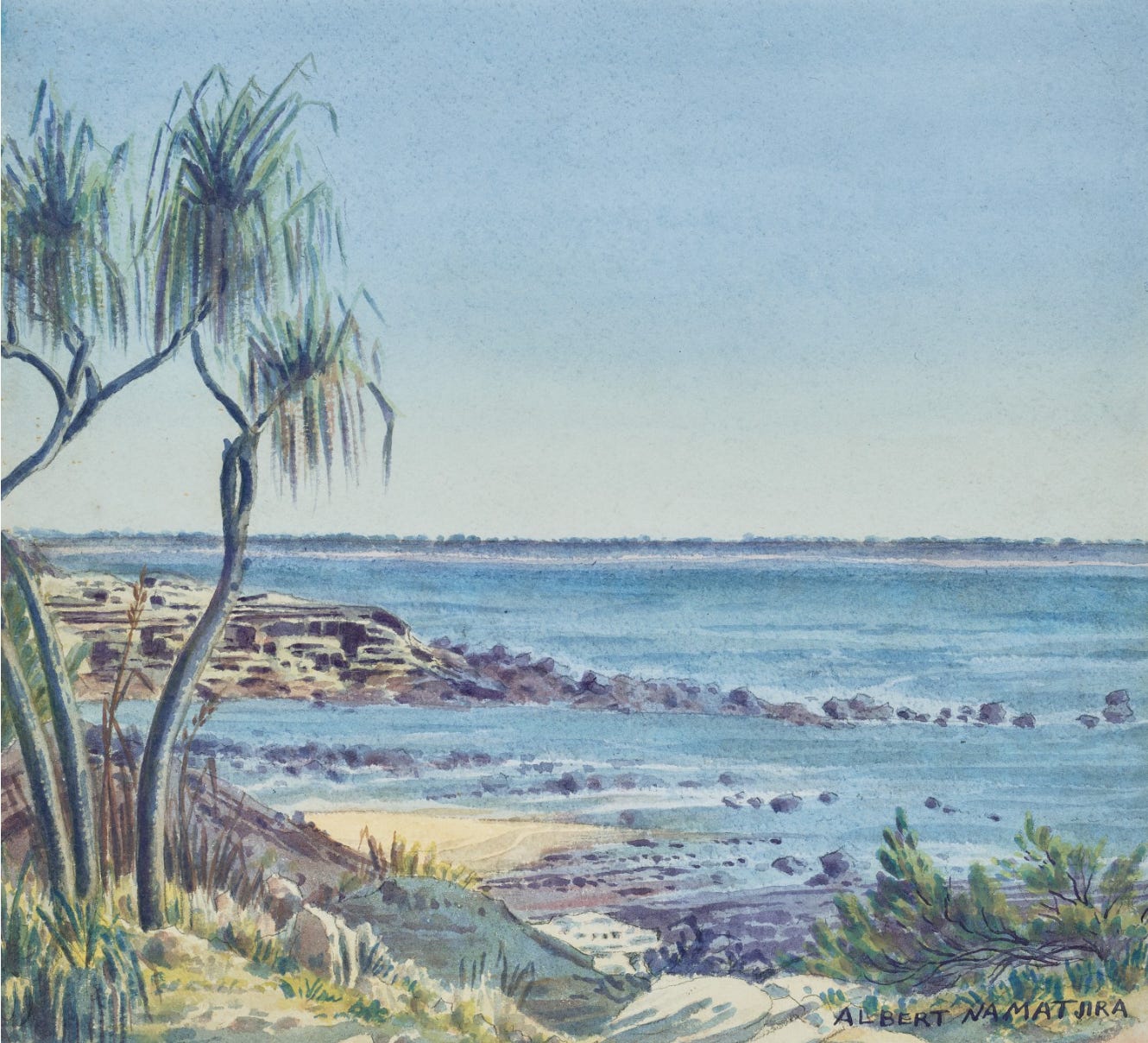
Namatjira’s fame brought both recognition and public scrutiny. He attracted prominent admirers, including Queen Elizabeth II, but his life also exposed the inequities faced by Aboriginal people. At the height of his fame, he was still denied basic rights available to non-Indigenous Australians, and his case became a powerful public symbol of that injustice.
Institutional recognition of his importance has been long-standing. The NGV’s Seeing the Centre (2003) positioned Namatjira as both a major national artist and a figure through whom the contradictions of Australian cultural history can be examined. More recently, NGV’s Watercolour Country (2023–24) placed his work alongside other Hermannsburg/Ntaria artists, reinforcing both his influence and the broader movement he helped shape.
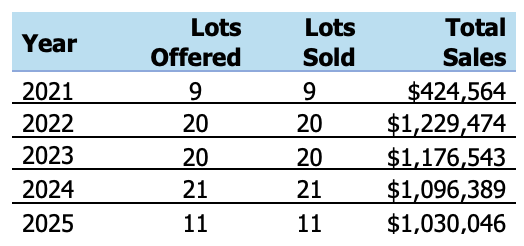
At auction, the market has clearly shifted higher. Between 2016 and 2021, annual sales averaged about $400,000. From 2022 to 2025, annual sales exceeded $1 million every year, including $1.03 million in 2025. While total value in 2025 was down 6.1% from 2024, this came on much lower volume (11 lots sold in 2025 vs 21 in 2024), resulting in a sharp rise in average price per work, from about $52,000 in 2024 to about $94,000 in 2025 (up ~79%). Just as importantly, sell-through has been exceptionally strong, with a 100% sell-through rate in each of the last five years.
Also notable for collectors is the continued visibility of the Namatjira name in contemporary Australian art. Albert Namatjira’s great-grandson, Vincent Namatjira, has achieved major national recognition in his own right, including winning the Archibald Prize in 2020, and has directly engaged with Albert’s legacy in works such as Albert’s Story.
The momentum continues into 2026
Six months into 2026, the evidence continues to support all three artists highlighted above.
For Criss Canning, the most interesting result was not another record but evidence that higher prices are spreading through her market. A 1995 Gum Blossom at Smith & Singer hammered for $230,000 against a $90,000–$120,000 estimate. Following the $405,000 record set in late 2025, it suggests collectors are increasingly prepared to pay six-figure prices for strong earlier works as well as her most desirable recent paintings.
Howard Arkley’s market has also held onto much of its 2025 repricing. Six of seven works offered in H1 2026 sold for a combined $2.71 million. Theatrical Façade realised $1.47 million and Freeway (Exit) $922,500, placing both among the ten highest-priced Australian works of the half-year. The supply was less exceptional than in 2025, but the price level remained high. That makes the extraordinary results of last year look increasingly like a genuine recalibration of Arkley’s market rather than a one-year anomaly.
The strongest follow-through may be Albert Namatjira. His 16 works offered during H1 2026 all sold, generating $1.21 million—already more than his total sales for the whole of 2025. None sold for more than $250,000, meaning the result was driven by consistent demand across a relatively large number of works rather than one trophy sale.
That market momentum is being reinforced by institutional attention. The National Gallery of Australia’s Hermannsburg display places Namatjira and the school he established at its centre, while House of Namatjira in the fifth National Indigenous Art Triennial brings his artistic legacy into the present through 57 members of his family and community.
All three therefore still look like artists having their moment. In Canning’s case, record prices are beginning to pull other works higher. For Arkley, the question of whether 2025 was an anomaly is starting to be answered. And for Namatjira, rising prices are being supported by perhaps the strongest combination of auction breadth and institutional attention of the three.
Methodology: Data has been compiled from six Australian auction houses: Art Leven, Bonhams, Deutscher and Hackett, Leonard Joel, Menzies, and Smith & Singer. The analysis covers auctions held between 1 January 2025 and 31 December 2025 and includes only sales primarily focused on fine art.